Biblical Prophecies Today: How to Discern Them
Bible prophecy is a message from God that stays faithful to Scripture, and Scripture is the test, not charisma, fear, or dramatic headlines. If a claim adds new doctrine, goes beyond the Bible, or won’t stand up to checking, treat it carefully. This guide focuses on discernment from Scripture, not on settling every end-times debate.
Key takeaways
- Test every prophetic claim against Scripture before you accept it, because not every religious-sounding message is from God.
- Use 1 John 4:1, Acts 17:11, and 1 Corinthians 14:29 as 3 clear checks: examine, weigh, and verify.
- Do not trust a prediction that claims certainty but fails to happen, because Deuteronomy 18:22 gives it a decisive test.
- Read the passage in context first, then compare cross references, especially when the New Testament names a fulfillment.
- Do not treat Revelation or Daniel as a codebook for fear, because interpretation starts with the text, not headlines.
What Bible prophecy is, and what it is not
Bible prophecy is God’s message delivered through human speech or writing, and it always agrees with the Bible already given. In the New Testament, that usually takes the form of exhortation, comfort, warning, or correction for a real person or congregation, not a rival canon. That’s why genuine prophecy points back to Scripture instead of putting itself above it.
This matters because some people hear the word prophecy and think only of future prediction. Scripture uses prophecy more broadly than that, and the church has often done the same when believers speak a timely word that strengthens faith, exposes sin, or calls for repentance. The real test isn’t how dramatic the message sounds, but whether it fits the Word of God.
A true prophetic word does not introduce a new doctrine, a secret timeline, or an authority that competes with the Bible. Phylicia Masonheimer describes modern prophecy as speech that comes from God and stays fully aligned with Scripture, which is exactly the guardrail readers need today. A message can sound spiritually earnest and still be wrong if it contradicts the canon.
This article stays on one question: how to discern prophetic claims from Scripture. It does not try to settle every difference between Christians on Daniel, Revelation, or the timing of final events, because those debates deserve their own careful treatment.
How Scripture tells you to test a prophetic claim
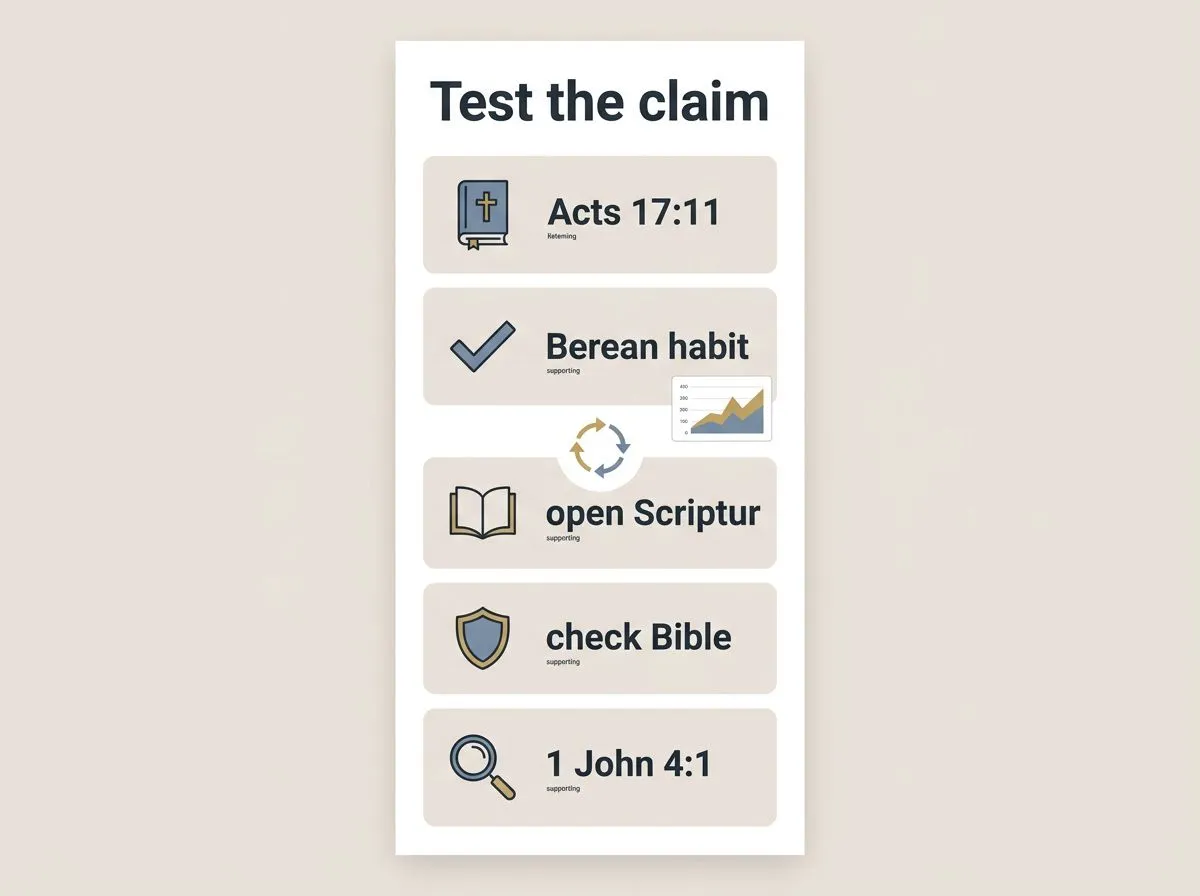
- Use the Berean habit from Acts 17:11, which means checking every claim against the Bible before you accept it.
- Obey 1 John 4:1, which tells you not to believe every spirit just because the language sounds religious.
- Remember 1 Corinthians 14:29, where prophecy is to be weighed by others, not treated as untouchable.
- Keep Deuteronomy 18:22 in view, because a claim that speaks for God must stand when the stated outcome arrives.
- Watch for warning signs: authority that competes with Scripture, pressure to obey immediately, wording so vague it cannot be checked, and messages that excuse contradiction instead of confronting it.
The Bereans are the model because they did something concrete: they listened closely, then opened the Scriptures to check the claim. That’s the opposite of spiritual passivity. If someone says God told them something, your first move is not to panic or applaud, but to compare the message with the Bible in context.
1 John 4:1 is direct because deception can sound spiritual. A polished voice, a confident platform, or a church setting does not make a claim true. If a message can’t survive close reading of Scripture, you don’t owe it trust just because it was delivered with conviction.
1 Corinthians 14:29 matters too because Paul expects prophecy to be weighed. That means believers are allowed, even required, to judge a prophetic claim by the Word of God and by whether the message produces good fruit in doctrine and conduct. In healthy church life, prophecy is submitted, not shielded from scrutiny.
Deuteronomy 18:22 gives a simple standard for a claim presented as a word from God: if it does not happen, it was not spoken by the Lord. That doesn’t mean every sincere believer who misspeaks is a false prophet, but it does mean people should be careful about anyone who attaches divine certainty to a specific prediction and then asks for immunity from accountability.
How to tell fulfilled prophecy from unfulfilled prophecy
You tell fulfilled prophecy from unfulfilled prophecy by starting with the passage itself and then letting Scripture identify Scripture. The immediate context comes first, because a verse lifted out of its setting can be made to say almost anything. After that, you compare cross references and look for whether the New Testament names a fulfillment already.
- Read the passage in its own chapter and book first. Ask who is speaking, to whom, and what historical situation is in view.
- Compare Scripture with Scripture. If the New Testament explicitly says a passage is fulfilled, let that control your reading.
- Check whether the prophecy has an immediate historical setting, a later fulfillment, or both. Some passages begin in one moment and reach farther than that moment alone.
- Do not push a text into the future just because it sounds dramatic. If the New Testament already identifies the fulfillment, the future application cannot cancel that identification.
Isaiah 7:14 is a clear example because Matthew 1:18 to 23 connects the virgin birth of Jesus to that prophecy. The New Testament does the interpretive work for you, so you’re not guessing in the dark. The same pattern appears with Hosea 11:1 and Matthew 2:15, where Matthew shows how the wording reaches beyond Israel’s past and finds its fullest meaning in Christ.
Zechariah 9:9 works the same way in the triumphal entry. The point isn’t that every prophecy functions identically, but that the New Testament sometimes gives you the fulfillment key outright. When it does, the safest reading is to follow that key instead of forcing the text into a new scheme.
Some prophecies carry an immediate setting and a deeper horizon, so one passage can have more than one layer. That’s why careful readers resist two mistakes at once: treating every prophetic text as already closed, or treating every difficult text as if it must still be waiting for the future. If the New Testament has already spoken, let it settle the matter.
Major ways Christians interpret Bible prophecy
Christians read Bible prophecy differently because they disagree on how literal, symbolic, historical, and future-oriented the texts should be taken. Those differences are real, but they do not mean every reading is careless. They mean the same books, especially Daniel and Revelation, are being approached through different interpretive lenses.
| Approach | How it reads prophetic language | How it handles fulfillment | Common concern |
|---|---|---|---|
| Literal reading | Takes prophetic language as directly as context allows, while still recognizing figures of speech | Looks for concrete fulfillment in history or future events | Can miss symbolism if it flattens apocalyptic imagery |
| Symbolic reading | Treats images as signs that point beyond the surface wording | Seeks theological meaning in the symbols and patterns | Can drift into speculation if symbols are detached from context |
| Historist reading | Connects prophecy to the sweep of church and world history | Reads fulfillment across eras rather than in one moment | Can become overly flexible if every age is made to fit |
| Futurist reading | Places much of Daniel and Revelation in the future, near Christ’s return | Holds that many details remain ahead of us | Can overlook passages the New Testament already treats as fulfilled |
These approaches explain why sincere believers can disagree without being careless or unfaithful. Four Approaches to Biblical Eschatology notes that no single approach fully accounts for the richness of biblical prophecy, which is a sober reminder for readers who want certainty too quickly. A wise reader holds convictions firmly, but not so tightly that context, genre, and cross references are ignored.
The book of Daniel is often where these differences show up first, and Revelation is where they intensify. Some interpreters stress the predictive shape of those books, while others emphasize their symbolic and pastoral force for believers under pressure. Either way, the question is not whether prophecy matters, but whether your reading is disciplined by the text itself.
If you want practical discernment, start with passages where the New Testament already shows you the link, then move to harder texts with humility. That keeps you from making prophecy a guessing game and from treating every current event as if it were a code waiting for your private key. Good discernment is patient, not sensational.
For readers who want to study further, editorial overviews from BibleHub, CIC Ministry, David Jeremiah Blog, GotQuestions.org, and Tim Challies all point to the same basic guardrails: test everything by Scripture, weigh it carefully, and don’t give unchecked authority to any message that claims to speak for God.
Verification checklist
- Read the prophecy in context, and the passage must make sense within its chapter and book before you apply it to yourself or current events.
- Compare the claim with clear biblical teaching, and the message must agree with Scripture instead of adding a new rule, doctrine, or timeline.
- Check whether the New Testament identifies a fulfillment, and the text must match that fulfillment instead of forcing a different meaning.
- Test the claim against 1 John 4:1 and 1 Corinthians 14:29, and the message must be willing to be weighed by other believers without demanding instant trust.
- If someone says the message is from God in a predictive sense, confirm whether Deuteronomy 18:22 is satisfied, and the stated outcome must actually occur as announced.
Frequently asked questions
Can a prophecy be true even if I do not understand it right away?
Yes. Some prophetic passages only become clear when later Scripture or later events shed light on them, so immediate clarity is not the first test. The safer test is whether the passage stays faithful to Scripture and whether the New Testament, like with Isaiah 7:14, shows you the fulfillment later.
Should I trust any modern claim that says it is from God?
No. A claim that sounds spiritual is not enough, because Scripture tells you to test every spirit and weigh prophetic speech. If the message adds new doctrine, competes with the Bible, or pressures you to trust it without checking, treat it carefully.
What is the safest starting point if I feel confused by end-times teaching?
Start with the passages the New Testament already helps explain, then move to harder texts like Daniel and Revelation. The article says to read the passage in context first, and to follow any New Testament fulfillment key when one is given. That keeps you from treating every headline or theory as a code to crack.
Do all Christians agree on prophecy interpretation?
No. Christians often agree on the authority of Scripture but differ on how prophetic language should be read, especially in Daniel and Revelation. The article notes that some readers lean literal, others symbolic, and others future-focused, so sincere believers can disagree without being careless.


A Letter From Jesus to You
Maybe you arrived here carrying thoughts that no one else knows about. Maybe everything seems fine on the outside, but inside, a battle is taking place. There…

Jesus Has a Word for Your Heart Today
Maybe you arrived here carrying thoughts that no one else knows about. It could be a concern about your family, an important decision, a financial struggle, or…

7 Promises From God for Difficult Times
Seven promises to pray in hard seasons, with clear context so you can trust God’s Word without misreading it.

A Practical Guide to Reading the Gospels
Read one Gospel at a time, keep sessions short, and notice each writer’s purpose so Jesus’ words stay clear.