
A Practical Guide to Reading the Gospels
If you want to read the Gospels with more clarity and less pressure, start with one Gospel, choose one readable translation, and keep your sessions short enough that you can finish well. A simple plan, a prayerful posture, and a bit of context will help you understand Jesus’ words without getting tangled up in four books at once.
Key takeaways
- Start with 1 Gospel, not all 4, and keep the same translation for your first 2 to 4 weeks.
- Use 1 short reading session daily, then end with 1 prayer and 1 written takeaway.
- Read in small sections, because one passage at a time is easier to understand than a full chapter rush.
- Check context and author’s purpose before you apply a verse, especially when a passage seems unclear.
This guide is for reading Matthew, Mark, Luke, and John. It is not about comparing every Bible version or trying to study the whole New Testament at the same time.
Start with one Gospel and build a simple daily habit
- Begin with one Gospel instead of trying to read all four at once, so you can follow the story clearly.
- Choose a readable English translation and stay with it while you are getting familiar with the text.
- Start with Mark if you want a fast-moving overview, or John if you want a more reflective view of Jesus.
- Pick a fixed time and place for reading, and keep the session short enough to finish without rushing.
- End each reading time with a short prayer and one written takeaway you can return to later.
Reading one Gospel at a time gives you a clearer path through Jesus’ life, teaching, death, and resurrection. Mark is often the easiest place to begin if you want momentum, while John helps you slow down and notice who Jesus is and why He came.
A readable translation matters because you are trying to hear the text, not fight through it. Bible Gateway’s reading resources also remind readers that prayer and reading belong together, so a short prayer before and after your session keeps the Bible from becoming just another item on a checklist Bible Gateway.
A fixed time and place make consistency easier. Morning before the day starts, a lunch break, or a quiet corner in the evening can all work if you can return to them without friction.
The written takeaway should stay small. One sentence is enough, a line about Jesus, a command to obey, or a promise to remember.
Use a simple flow for each reading session
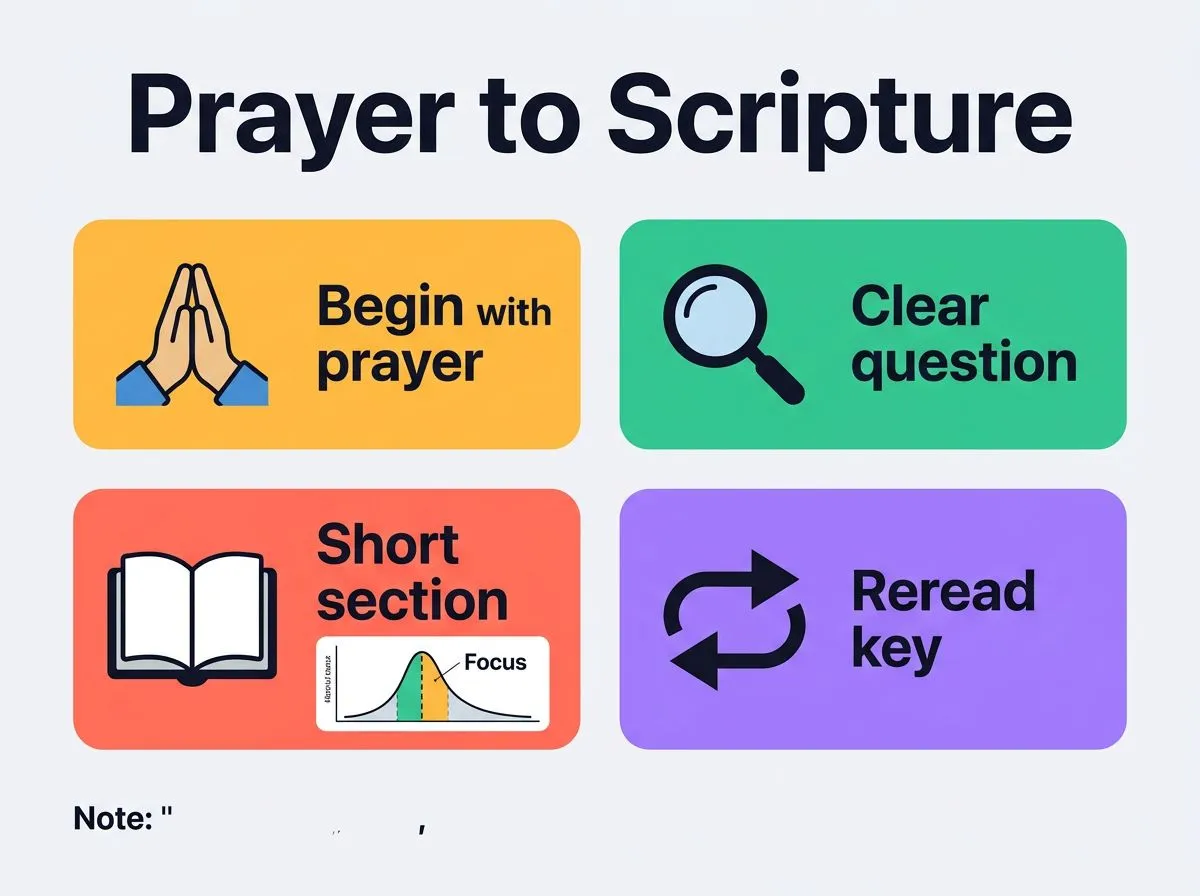
- Begin with prayer and a clear question, such as what this passage shows about Jesus or what it teaches about faith.
- Read a short section at one sitting so you can follow the movement of the passage.
- Reread key lines slowly and pay attention to repeated words or phrases.
- Stay in the same Gospel for a while before moving to another one, so the writer’s message stays clear.
- Summarize the main point in one sentence, then note one prayer or act of obedience that follows from it.
Prayer gives your reading direction before your eyes move to the page. A simple question, like what this passage reveals about Jesus, keeps you from drifting into unrelated thoughts and helps you read with purpose.
Short sections are easier to understand because Gospel writers build meaning through movement, scene, and contrast. If you read too much at once, you may remember facts but miss the point of the passage.
Rereading is where details begin to stand out. A repeated name, a shift in tone, or a repeated phrase often shows you where the author wants your attention to land.
Staying in one Gospel for a season helps you hear the writer’s voice. That matters because each Gospel presents Jesus with its own emphasis, and switching too quickly can blur that emphasis.
Bible Gateway’s reading plans also make this kind of steady rhythm easier, including options like reading through the Gospels in 40 days or following the classic M’Cheyne plan, which spreads readings across the Old Testament, New Testament, Psalms, and Gospels Bible Gateway Reading Plans.
Read with the writer’s purpose and context in mind
- Ask what the Gospel writer wants the reader to understand about Jesus.
- Notice who the audience seems to be and why that matters for the way the story is told.
- Look for repeated themes such as kingdom, faith, signs, fulfillment, and discipleship.
- Pay attention to historical context and to how each passage fits into the larger story of Jesus’ life and ministry.
- Read the passage as a whole unit, not as a set of isolated verses, so you can hear the emphasis correctly.
The writer’s purpose is the first thing to notice because it tells you what kind of reading you are doing. Dr. Trent Rogers of Cedarville University explains that authorial intent matters in the Gospels, and that you can discern it from the text itself rather than guessing from a single verse Cedarville University.
Audience matters because the same event can be told from a different angle depending on who is being addressed. That does not make one Gospel less true than another, it means each writer is arranging the material to communicate something specific about Jesus.
Repeated themes are the easiest way to trace that purpose. When you keep seeing kingdom language, calls to faith, signs, fulfillment, or discipleship, you are seeing the writer’s emphases in plain view.
Historical context helps you avoid flattening the passage into a private devotional quote. Read the section as a whole unit, then ask how it fits into Jesus’ larger ministry, not just what a single sentence might mean by itself.
Crossway puts the same idea in practical terms by noting that the way a biblical author puts a passage together shows what the author means to emphasize and highlight Crossway.
Avoid the most common mistakes when learning how to read the Bible
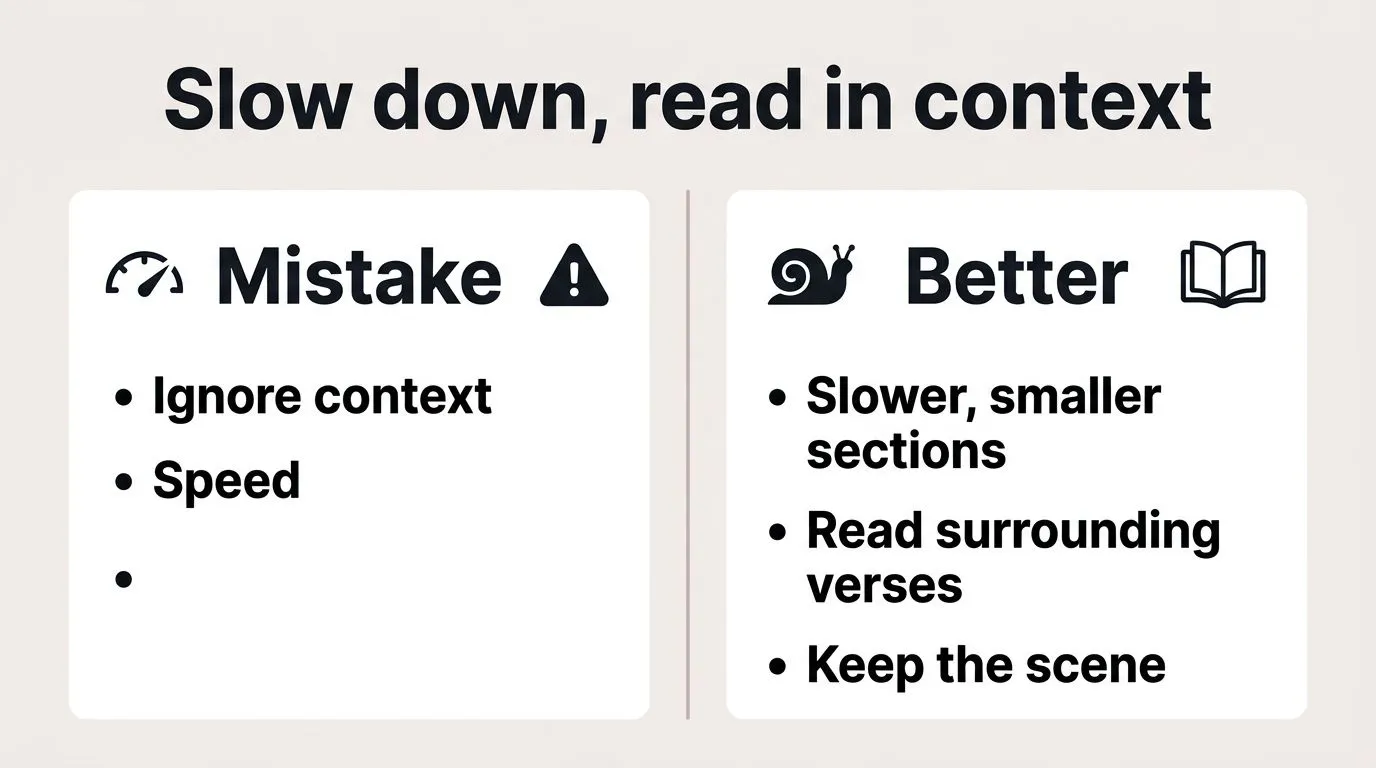
- Do not read too much at once, correct this by slowing down and using smaller sections.
- Do not ignore context, correct this by reading the surrounding verses and noticing who is speaking.
- Do not treat every verse as a stand-alone promise, correct this by asking what the passage meant first.
- Do not compare too many translations too early, correct this by using one main translation until the flow becomes familiar.
The biggest beginner mistake is speed. Desiring God points out that Bible reading takes focus and the ability to sit with the text, which means rushing through chapters can leave you with information but little understanding Desiring God.
Context problems usually start when a verse is lifted out of the scene around it. Read the verses before and after the passage, and pay attention to who is speaking, who is listening, and what question is being answered.
Treating every line as a direct promise can distort the meaning of the passage. Some verses comfort, some correct, some reveal who Jesus is, and some describe a moment that should be understood in its own setting before you apply it to your life.
Too many translations too soon can also make reading feel fragmented. It is better to settle into one main translation first, then compare others later if a phrase feels unclear or you want to see another angle.
If you need help staying steady, a few reading tools can make the habit easier without turning it into a project. The Navigators offer plans with daily New Testament reading and built-in catch-up days, and the Church of Jesus Christ Gospel Library includes Bible reading, study guides, and audio options for reading on the go Navigators, Church of Jesus Christ Gospel Library.
Which Bible tools are actually helpful for Gospel reading?
The most useful tools are the ones that keep you reading, not the ones that leave you feeling ready forever. Bible Gateway is handy for reading and comparing passages, Bible Gateway Reading Plans give you structure, and the Gospel Library app works well if you want Bible reading and audio in one place.
If you like guided devotionals, Desiring God and LifeTeen both model a prayer-first, Scripture-first approach. Cedarville University and Crossway are helpful when you want to think carefully about the writer’s purpose and emphasis. The point isn’t to collect resources, but to choose one or two that fit your attention span and stay with them.
How do you know you are reading the Gospels well?
You are reading the Gospels well when you can say, in plain language, what the passage shows you about Jesus and what response it calls for. That response may be belief, repentance, gratitude, patience, or a concrete act of obedience.
A good reading habit leaves you with less confusion and more clarity over time. You don’t need to understand every detail on day one, but you should be able to follow the main movement of the passage and see why it matters.
If you want a steady yearly rhythm, the classic M’Cheyne plan is one proven way to keep the Gospels in front of you without making them the only thing you read. If you want a faster start, a short plan like the Gospels in 40 Days may fit your current season better, especially if you’re starting again after a long break.
Keep the goal simple and faithful
The goal isn’t to read the Gospels quickly, but to meet Jesus clearly in the text and respond to Him in faith. That means your next step is to choose one Gospel, one translation, and one reading time, then start small enough that you can keep going tomorrow.
After that, decide whether you need a guided plan, a study tool, or a quieter pace. The best choice is the one that fits your attention, your schedule, and your willingness to stay with one passage long enough to hear what it is really saying.
Frequently asked questions
Should I read one Gospel straight through or jump between them?
Read one Gospel straight through first. That helps you follow the writer’s flow, notice repeated themes, and understand Jesus’ ministry as a whole. Mark is a strong first choice if you want momentum, while John works well if you want a slower, more reflective pace.
What if I miss a few days in my Bible reading routine?
Just restart at the next short section instead of trying to catch up all at once. Consistency matters more than perfection, and a steady rhythm is easier to keep when your reading time stays short enough to finish without rushing. A fixed time and place can also help you start again without friction.
Is it okay to use a study Bible while I learn how to read the Bible?
Yes, as long as you read the text first and let the notes support your understanding instead of replacing it. A study Bible can help, but the article’s main point is to keep the passage in front of you before turning to tools or comments. That keeps Scripture primary and the notes in their proper place.
Which Gospel is easiest for beginners?
Mark is often the simplest place to start if you want a fast-moving account, while John is a strong choice if you want a more reflective view of who Jesus is. If you are brand new, either one can work well, but Mark usually gives you quicker momentum and John helps you slow down and notice Jesus more carefully.


A Letter From Jesus to You
Maybe you arrived here carrying thoughts that no one else knows about. Maybe everything seems fine on the outside, but inside, a battle is taking place. There…

Jesus Has a Word for Your Heart Today
Maybe you arrived here carrying thoughts that no one else knows about. It could be a concern about your family, an important decision, a financial struggle, or…

7 Promises From God for Difficult Times
Seven promises to pray in hard seasons, with clear context so you can trust God’s Word without misreading it.

Common Sins That Displease God and How to Avoid Them
Scripture names sins that quietly shape daily life. Learn how repentance, truth, and obedience help you turn back to God.