
7 Promises From God for Difficult Times
God’s promises are steady comforts in hard seasons, but they aren’t all meant the same way. Some verses give broad encouragement to believers, while others were spoken to a specific person, nation, or moment. The safest way to pray them is to read them in context, then bring them to Christ.
Key takeaways
- Isaiah 41:10 gives you 4 anchors in one verse: God is with you, strengthens you, helps you, and upholds you.
- Philippians 4:6-7 points to 1 practical response to anxiety: pray, give thanks, and receive God’s peace.
- 2 Chronicles 7:14 is a conditional promise, so read the if-then structure before applying it to your own situation.
- 2 Corinthians 1:20 keeps every promise centered on Christ, which helps you pray Scripture without isolating one verse from the gospel.
What God’s promises mean in difficult times
God’s promises give you hope in grief, fear, and pressure, but each one should be read in its original setting before you pray it. A promise is God saying He will do something. A principle is a wise truth that usually holds true, but it is not written as a direct pledge to every person in every situation.
That distinction matters because Scripture holds both broad comfort and specific covenant language. Isaiah 41:10 can steady a frightened heart with God’s presence and help, while 1 Kings 9:5 speaks to Solomon in a way that does not automatically transfer to every believer as if it were written to us first.
The center of the whole subject is Jesus Christ. 2 Corinthians 1:20 says that all God’s promises find their Yes in Him, which means Christians read the promises through the gospel, not as isolated motivational lines pulled out of the Bible.
That keeps you from flattening the Old Testament into a list of personal guarantees. A promise given to Israel, a king, or a prophet still reveals God’s character, but it is not automatically a direct promise about your exact circumstance today.
7 promises from God to hold onto in hard seasons
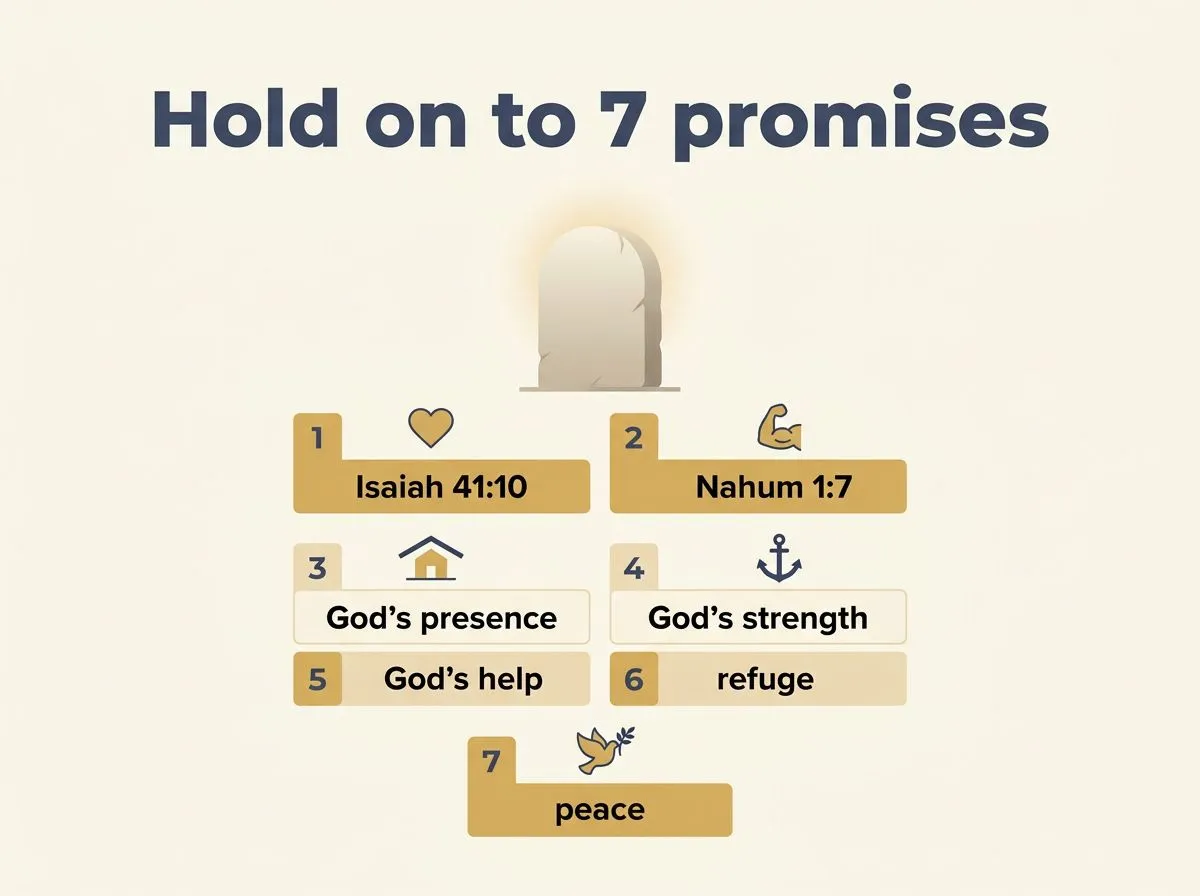
- Isaiah 41:10 promises God’s presence, strength, help, and sustaining power when fear is loud and discouragement feels heavy.
- Nahum 1:7 calls God a refuge in trouble, and its prophetic setting shows that His comfort stands even when judgment is part of the larger message.
- Philippians 4:6-7 promises peace through prayer, as Paul speaks to believers who are told to bring anxiety to God instead of carrying it alone.
- 2 Chronicles 7:14 is a conditional covenant promise for Israel, so Christians should receive its call to humility and repentance without turning it into a blanket national guarantee.
- 1 Kings 9:5 shows how specific some promises are, because God speaks to Solomon about a royal throne in a way that cannot be detached from that moment.
- 2 Corinthians 1:20 teaches that every promise finds its fulfillment in Christ, which is why the gospel is the key for reading the rest of Scripture faithfully.
- Taken together, these passages steady you with real hope, but they also teach you to honor the wording, audience, and purpose of each verse instead of forcing it to say more than it does.
Isaiah 41:10 gives you strength when fear feels bigger than you
Isaiah 41:10 tells you not to fear because God is with you, strengthens you, helps you, and upholds you. It speaks right into those moments when your hands are shaking and your thoughts keep running ahead of you.
The practical comfort is simple. You do not have to manufacture courage before you come to God. You come afraid, and He meets you with His presence first, then with strength for the next step.
A faithful prayer sounds like this: “Lord, You said You are with me. Strengthen me today, help me with what I cannot carry, and hold me steady when I’m tempted to panic.”
Nahum 1:7 makes God your refuge in trouble
Nahum 1:7 says that the Lord is good, a stronghold in the day of trouble, and He knows those who take refuge in Him. The surrounding prophecy is serious, since the book also speaks about judgment, which means this comfort is not shallow optimism.
That matters because many people want only the comforting line and skip the rest. Nahum shows that God’s refuge is real even when life is not soft, predictable, or fair in the short term.
Pray it this way: “Lord, be my refuge in this trouble. Let Your goodness be what I lean on, and keep me close to You instead of running to lesser shelters.”
Philippians 4:6-7 answers anxiety with prayer and peace
Philippians 4:6-7 tells anxious believers to bring everything to God in prayer, with thanksgiving, and receive the peace of God that guards heart and mind. Paul is not denying pressure. He is redirecting it.
The promise here is not that every hard situation disappears quickly. It is that God gives peace that does guard you while the circumstance is still there, which is exactly why this passage has comforted Christians in hospitals, job loss, and sleepless nights.
A simple prayer fits the text: “Father, I bring You this worry, this bill, this diagnosis, this family tension. Guard my heart and mind with Your peace as I trust You.”
2 Chronicles 7:14 calls for humility, not a slogan
2 Chronicles 7:14 is a covenant call to Israel, and it is conditional from the start: if God’s people humble themselves, pray, seek His face, and turn from wicked ways, then He will hear, forgive, and heal. That means the verse cannot be reduced to a blank check for any nation on earth.
For Christians, the passage still matters because it shows how God responds to repentance. But you should not flatten it into a promise that your country will be healed on demand if enough people repeat the verse.
The prayer use is personal and honest: ask God to search you, humble you, and turn your heart back to Him. The political use is where readers often go wrong, because the text is first about covenant faithfulness, not a modern campaign slogan.
1 Kings 9:5 shows why context protects you from misreading Scripture
1 Kings 9:5 is a direct promise to Solomon about his royal throne, and that specificity is the lesson. The chapter makes clear that God is addressing a particular king in a particular covenant setting, not speaking in general terms to every reader.
This is where many sincere Christians get tripped up. They see a blessing, claim it without checking who heard it first, and then feel disappointed when life does not match the wording they borrowed.
Read specific promises as windows into God’s character, not as loose promises detached from the scene. That keeps your faith honest and your prayer grounded.
2 Corinthians 1:20 puts every promise under Christ
2 Corinthians 1:20 says that all God’s promises are Yes in Christ, and that truth holds the whole Bible together. Jesus is not just one promise among many. He is the one who fulfills them, which is why the rest can be trusted.
That’s why teachers like Greg Holder, Billy Graham Daily Devotion, JD Greear Ministries, Phylicia Masonheimer, GotQuestions.org, and Desiring God keep telling readers to read promises in context, not pull out isolated lines. Desiring God
When you pray through hardship, this matters because Christ keeps the promise from shrinking into a quote on a card. He turns it into a gospel-shaped hope that reaches deeper than whatever outcome you’re facing right now.
How to pray God’s promises without misreading them
You pray God’s promises faithfully by reading the verse in context, asking who it was first spoken to, and then bringing the revealed character of God back to Him in your own words. That keeps your prayer grounded in Scripture, not drifting into something magical.
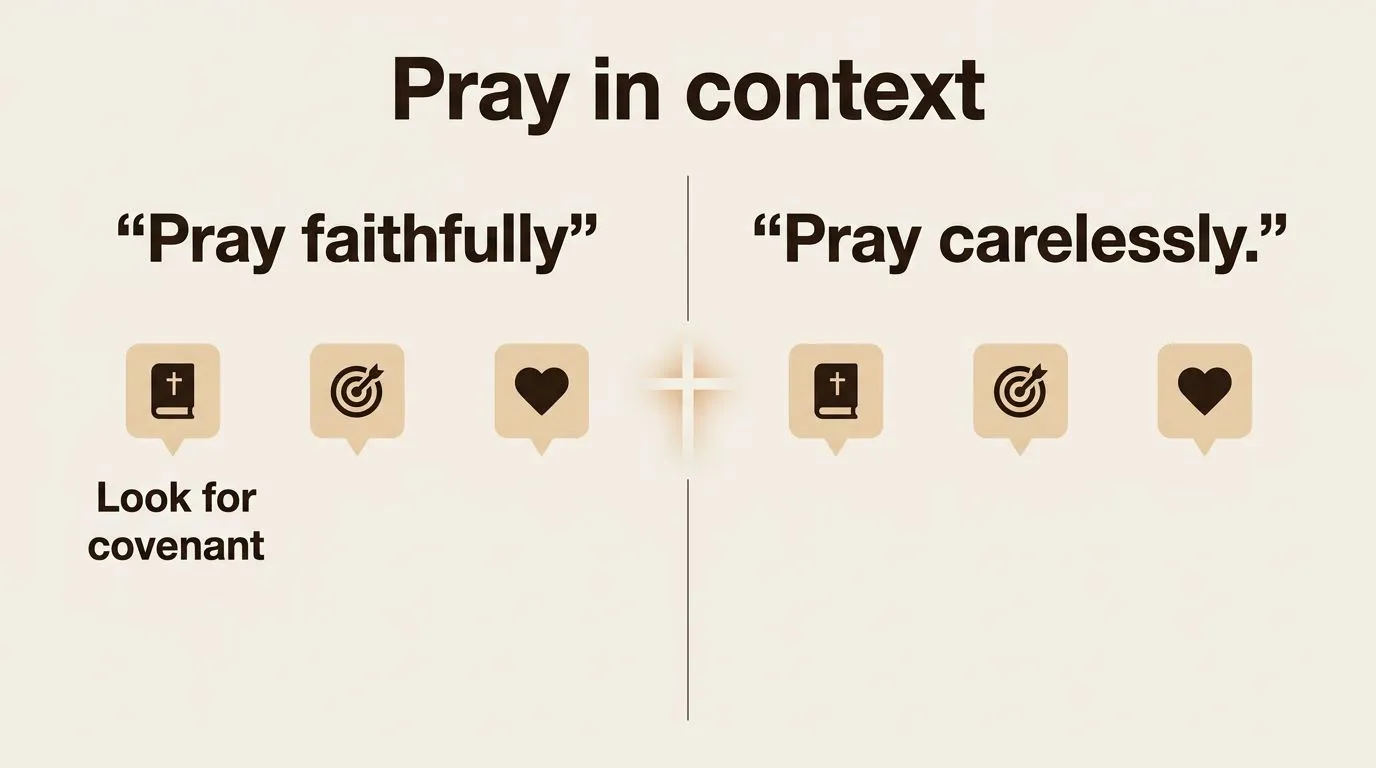
- Read the verses before and after the promise so you can hear the full thought, not just the line you like.
- Ask who received the promise first, and notice whether the passage includes an if, a covenant, or a specific situation.
- Look for what the passage shows you about God, such as His presence, refuge, peace, or faithfulness.
- Pray the truth of the passage back to God without demanding that it mean more than Scripture says.
- Use a simple pattern: name the need, name the verse, ask for God’s help, and trust His timing and wisdom.
That last step matters in grief, anxiety, waiting, or uncertainty, because prayer is not a lever you pull to force an outcome. It is how you place your fear under God’s rule and ask Him to meet you according to His Word.
Hold the promise, keep the context
The best next step is to decide whether a verse is being used as comfort, as a covenant statement, or as a Christ-centered fulfillment, because each one should be prayed in a different way. For example, if a verse was first spoken to Solomon or to Israel, take the lesson about God’s faithfulness, then pray, “Lord, make me faithful to You,” instead of treating the promise as if it were first spoken to your exact situation.
You also need to decide whether you are asking for relief, endurance, repentance, or waiting, because the way you pray changes with the need. In grief, ask God to be near and to carry what you cannot. In anxiety, ask for peace. In repentance, ask for mercy and a clean heart. In waiting, ask for patience and trust.
Finally, decide whether you are reading the verse as a direct promise or as a window into God’s character, because that protects you from disappointment and keeps your hope rooted in Christ. That is how you stand on Scripture without bending it.
Frequently asked questions
Can I pray a promise from the Bible even if it was first spoken to someone else?
Yes, if you pray it through the lens of the whole Bible and the character of God, not as a guarantee detached from context. The article’s key safeguard is to bring that promise to Christ, since 2 Corinthians 1:20 says God’s promises find their Yes in Him. That keeps a verse like Isaiah 41:10 as real comfort without turning every Old Testament promise into a private contract.
How do I know if a promise is conditional?
Check for an explicit if, then read the verses around it and ask whether the passage is tied to a covenant, a specific people, or a particular situation. The article uses 2 Chronicles 7:14 as a clear example of a conditional covenant promise to Israel, not a blanket national guarantee. If the wording is specific, the promise usually is too.
What should I do when a promise does not seem to come true the way I hoped?
Return to the wider context, trust God’s wisdom and timing, and look for the promise’s deeper purpose in forming faith, hope, and endurance. The article also reminds you that some promises are fulfilled in Christ in ways that go deeper than the outcome you expected. That means disappointment is a cue to reread, pray, and ask what God was forming in you, not to assume He was unfaithful.
Are there promises in the Old Testament that are not meant to be applied directly to America or the modern church?
Yes. Some promises were made to Israel, Solomon, or a specific generation, and they should not be flattened into national guarantees for today. The article points to 1 Kings 9:5 and 2 Chronicles 7:14 as examples, showing that their main value for Christians is what they reveal about God, not a direct promise to the United States.


A Letter From Jesus to You
Maybe you arrived here carrying thoughts that no one else knows about. Maybe everything seems fine on the outside, but inside, a battle is taking place. There…

Jesus Has a Word for Your Heart Today
Maybe you arrived here carrying thoughts that no one else knows about. It could be a concern about your family, an important decision, a financial struggle, or…

A Practical Guide to Reading the Gospels
Read one Gospel at a time, keep sessions short, and notice each writer’s purpose so Jesus’ words stay clear.

Common Sins That Displease God and How to Avoid Them
Scripture names sins that quietly shape daily life. Learn how repentance, truth, and obedience help you turn back to God.