
7 Best Bible Chapters to Renew Your Faith
Some Bible chapters talk about faith so directly that you can read them slowly, pray through them, and still walk away feeling steadier. Hebrews 11, James 2, Romans 4, and Matthew 17 fit that description because they show faith as belief, obedience, trust, and dependence on God in real life.
Key takeaways
- Hebrews 11 gives 1 clear definition of faith, then shows it through biblical examples.
- James 2 makes the decision point plain: faith without works is dead.
- Romans 4 centers faith on Abraham’s trust in God’s promise, not visible proof.
- Matthew 17 reminds you that even mustard-seed faith can depend on God’s power.
- A simple 7-day reading plan lets you pray 1 chapter each day and apply 1 act of obedience.
The Bible chapters that speak most clearly about faith

- Hebrews 11 is the clearest faith chapter, because it defines faith in Hebrews 11:1 and then shows it through the lives of men and women who trusted God before they saw the outcome.
- James 2 connects faith to action, especially in James 2:17, where faith without works is described as dead.
- Romans 4 centers faith in Abraham’s belief and in God’s promise, making it one of the strongest chapters for understanding how faith receives what God has spoken.
- Matthew 17 highlights faith like a mustard seed and shows how faith depends on God’s power, not your own strength.
What each chapter teaches about faith
| Chapter and key passage | Main theme | Faith-focused message | Recurring concept or verse |
|---|---|---|---|
| Hebrews 11, especially 11:1 | Faith as assurance and conviction | Faith means trusting God before visible proof arrives, and the chapter backs that definition with a long chain of examples from Scripture. | "The assurance of things hoped for" and "the conviction of things not seen" |
| James 2, especially 2:17 | Faith shown through obedience | Faith that stays hidden and never moves into action is incomplete, so real belief shows up in what you do. | "Faith by itself, if it has no works, is dead" |
| Romans 4 | Faith and God’s promise | Abraham believed God, and that belief becomes a model for how God counts faith as righteousness. | Abraham believed what God promised |
| Matthew 17, especially 17:20 | Faith that trusts God’s power | Even small faith matters when it is placed in a great God, and the chapter calls you away from self-reliance. | "If you have faith like a grain of mustard seed" |
How these chapters work together to strengthen belief
Together, these chapters move from inner confidence to outward obedience. Hebrews 11 lays the foundation: faith is not wishful thinking, but assurance and conviction rooted in God’s character. James 2 then brings that truth into everyday life, because belief that never changes your choices is still unfinished.
Romans 4 helps when you start measuring faith by how strong it feels. Abraham trusted God’s promise before he had visible proof, which shows that faith often looks like steady confidence instead of dramatic emotion. That matters on ordinary days, when obedience feels slow and prayer feels quiet.
Faith that hears, trusts, and obeys
Matthew 17 brings the focus back to dependence. Jesus points his disciples toward faith that leans on God’s power, not on the size of the person holding it. That is why related passages matter here too, including Romans 10:17, which says faith comes from hearing the word of Christ, Proverbs 3:5-6, which calls you to trust the Lord with all your heart, and 2 Corinthians 5:7, which says we walk by faith, not by sight.
Taken together, these chapters do not hand you a vague spiritual mood. They give you a pattern: hear God’s word, trust what he says, act on it, and keep walking when the result still isn’t visible. OpenBible.info’s topical list on faith shows how often Scripture returns to that theme, and that repetition helps keep faith from shrinking into a private feeling. OpenBible.info
When doubt feels stronger than certainty
If you are wrestling with doubt, John 20:29 is a helpful companion because it blesses those who believe without seeing. Habakkuk 2:4 points the same way: the righteous live by faith. Those verses keep these chapters from turning into theory, because they speak to the exact moment when you want proof first and trust second.
How to read and pray through these chapters this week
A simple one-chapter-a-day rhythm usually works best, because it keeps the Bible passage in front of you long enough to notice repeated words and commands. Crossway and Christian Aid both highlight these faith passages in their teaching resources, which is a good reminder that this is not a fringe theme, but a central one in Christian reading. Crossway
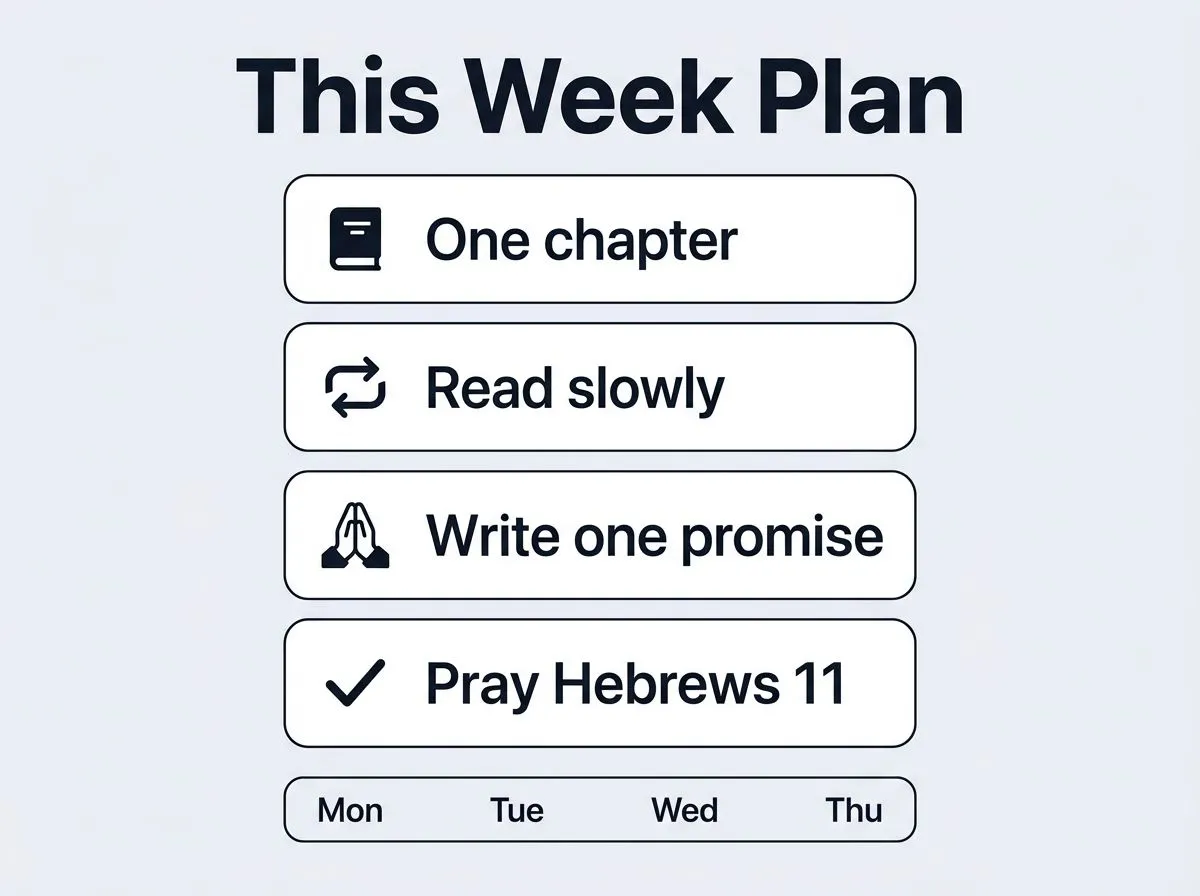
- Choose one chapter per day and read the full chapter slowly, preferably in one sitting so you can follow the argument from beginning to end.
- Write down one repeated word, promise, or command from the chapter, then circle the phrase that seems to carry the main burden of the passage.
- Pray the chapter back to God in your own words, turning the text into worship, confession, thanksgiving, or request.
- End by asking for one concrete act of obedience or trust, something small enough to do that day and specific enough to test your faith in practice.
A simple prayer pattern for each chapter
You can pray Hebrews 11 by asking God to make your faith steady before the outcome is visible. You can pray James 2 by asking for obedience that matches what you say you believe. You can pray Romans 4 by asking for Abraham-like trust in God’s promise, and Matthew 17 by asking for childlike dependence on God’s power rather than your own control.
If you want one place to start, begin with Hebrews 11 and read it out loud. Then move to James 2 the next day, Romans 4 after that, and Matthew 17 last, because that sequence takes you from definition to action to promise to trust. It is a short path, but it’s enough to renew your attention and help you pray with more honesty.
Let these chapters shape what faith looks like for you this week: hearing God clearly, trusting him before you see the result, and taking the next obedient step. That is the kind of faith Scripture keeps honoring, and it is the kind that grows stronger when you return to the Word with a willing heart.
Frequently asked questions
Which chapter is most often called the faith chapter?
Hebrews 11 is most often called the faith chapter because it defines faith in Hebrews 11:1 and then backs that definition with example after example from Scripture. If you want one chapter that clearly shows faith before visible proof arrives, this is the one most readers start with.
Is faith in the Bible only about believing?
No. James 2 makes it clear that faith is meant to show up in obedience, not stay hidden as an idea. The chapter’s point is that real belief moves into action, so faith and works belong together.
What chapter should I read if I feel weak in faith?
Hebrews 11 and Matthew 17 are both strong places to start. Hebrews 11 helps you steady your view of what faith is, while Matthew 17 reminds you that even mustard seed-sized faith matters when it is placed in God’s power, not your own strength.
Are there verses outside these chapters that also belong in a faith study?
Yes. Romans 10:17, Proverbs 3:5-6, and 2 Corinthians 5:7 fit naturally alongside these chapters because they reinforce the same pattern of hearing, trusting, and walking by faith. John 20:29 and Habakkuk 2:4 are also helpful if you want passages that speak to doubt and waiting for what you cannot yet see.
Should I read these chapters in a certain order?
Yes, if you want a simple flow, start with Hebrews 11, then read James 2, move to Romans 4, and finish with Matthew 17. That order takes you from faith’s definition to faith in action, then to faith in God’s promise and faith that depends on his power.


A Letter From Jesus to You
Maybe you arrived here carrying thoughts that no one else knows about. Maybe everything seems fine on the outside, but inside, a battle is taking place. There…

Jesus Has a Word for Your Heart Today
Maybe you arrived here carrying thoughts that no one else knows about. It could be a concern about your family, an important decision, a financial struggle, or…

7 Promises From God for Difficult Times
Seven promises to pray in hard seasons, with clear context so you can trust God’s Word without misreading it.

A Practical Guide to Reading the Gospels
Read one Gospel at a time, keep sessions short, and notice each writer’s purpose so Jesus’ words stay clear.