
Study Bible or Regular Bible: Which Should You Choose?
A study Bible isn’t automatically the better Bible, and a regular Bible isn’t automatically the lesser one. If you want less help and more space to hear the text on its own, go with a regular Bible. If you want notes, cross-references, maps, and explanations right beside the text, a study Bible makes more sense.
Key takeaways
- If you want to read steadily this week, choose the Bible you are most likely to open 7 days in a row.
- If you study hard passages, look for notes that point you back to Scripture, not pages of opinions.
- If your church uses a common translation, matching it can reduce confusion every Sunday.
- If a Bible feels dense on page 1, try a clearer translation before buying a more annotated edition.
This guide is about choosing the format that fits your goal, whether you’re reading devotionally, getting ready for church, or beginning deeper study. It does not cover specialty editions like interlinear Bibles or reader’s Bibles, since those solve different problems.
What is the difference between a study Bible and a regular Bible?
| Feature | Study Bible | Regular Bible |
|---|---|---|
| Text on the page | Biblical text plus notes, cross-references, maps, charts, and footnotes | Biblical text with minimal extra material |
| Help level | High, because the page explains context and difficult passages as you read | Low, because the text stands mostly on its own |
| Best use case | Deeper study, teaching prep, and reading with context close at hand | Devotional reading, church use, and reading a passage without constant interruption |
A study Bible gives you explanation beside the text, while a regular Bible gives you the text with little interruption. Holston Conference of the United Methodist Church describes study Bibles as editions that add notes, maps, charts, illustrations, quotes, and special formatting around the biblical text, while regular Bibles keep the focus on the text itself Holston Conference of the United Methodist Church.
That difference matters because the extra material changes how you read. A study Bible slows you down in a good way, which helps when you want context, interpretive help, or background for a hard passage. A regular Bible works better when you want to keep moving through Scripture without checking a sidebar every few lines.
If your goal this week is to build a steady habit, a regular Bible can be the easier place to start. If your goal is to understand why a passage says what it says, a study Bible can save time and confusion. The best choice is the one that matches the kind of reading you’ll actually do.
How do you choose the right translation for study?
You choose the right translation for study by finding the balance between readability, accuracy, and the way your church already talks about Scripture. Global University notes that translation matters because biblical language moves between Hebrew, Greek, and English, and words can carry more than one sense Global University.
Readability is the first practical test. If a translation feels dense every time you open it, you’ll probably read less. The Bible Seminary says readability is about how naturally and clearly the text flows in modern English, and that matters because a clear page is easier to keep reading than one that feels stiff or overly technical The Bible Seminary.
The next question is how literal you want the wording to be. More formal translations stay closer to the structure of the original languages, which can help with close study, word comparisons, and sermon prep. More thought-for-thought translations aim to carry the sense into smoother modern English, which often helps first-time readers follow the line of thought.
That’s why many readers compare the NIV, NRSV, and CEB when choosing a study Bible or a regular Bible. Calvin Institute of Christian Worship notes that NIV aims to balance accuracy and readability, while the NRSV and CEB are also widely used, with the CEB written at a seventh-grade reading level Calvin Institute of Christian Worship. If you want a Bible you can read daily without losing the meaning, that balance matters more than choosing the one that sounds most formal.
For church use, let familiarity count too. If your congregation already reads from one translation in worship, choosing the same one for personal study can reduce friction when you hear a passage aloud on Sunday and open your Bible at home. If you’re starting fresh, read Psalm 23 and Ephesians 2 in two or three translations side by side, then choose the one that sounds clear without flattening the meaning.
What should you look for in study notes and other helps?
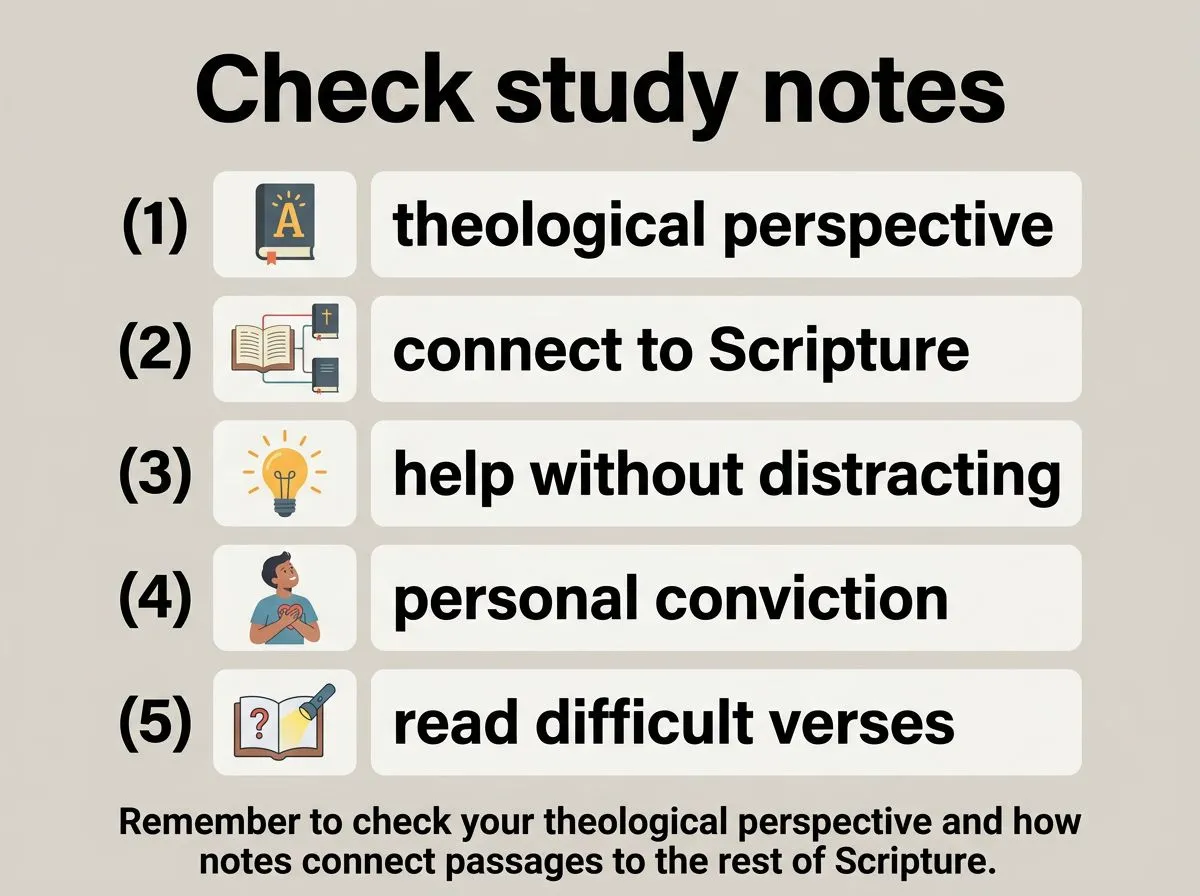
- Check the theological perspective first, because study notes always reflect a point of view and you want to know whether that view fits your church or personal convictions.
- Look for notes that send you back to Scripture with cross-references, alternate renderings, and brief explanations instead of long opinions.
- Pay attention to whether the notes help you understand the passage or crowd the page so much that the Bible text becomes hard to find and read.
- Use the publisher’s sample pages before you buy, because a well-designed study Bible can still feel cluttered if the notes are too heavy or the font is too small.
- If you want academically oriented notes, compare widely respected options such as the New Oxford Annotated Bible and the HarperCollins Study Bible, both known for scholarship that helps readers understand texts in their original context Study Bibles | Religious Studies Center.
A good study Bible does more than explain difficult verses. It helps you see how a passage connects to the rest of Scripture, and it does that without making every page feel like a textbook. The Colorado Christian University Library’s research guide points readers toward commentaries, concordances, atlases, and viewpoint-based resources, which is a useful reminder that solid study helps are organized tools, not just extra paragraphs in the margin Colorado Christian University Library.
That’s also where theological fit matters. A Bible with notes shaped by one tradition may be a strength if that tradition is your home, but a poor fit if you need something broader for church or classroom use. If you’re unsure, ask, ‘Will these notes help me see the passage more clearly, or will they quietly steer me before I’ve finished reading it?’
Which beginner Bible features matter most?
- Maps and timelines help you place people, cities, and events in order so the Bible feels less like disconnected pieces and more like a shared story.
- A concordance helps you find repeated words, themes, and related verses when you remember a phrase but not the exact reference.
- Clear headings, readable type, and open spacing make it easier to keep your place, especially if you read in the morning or carry the Bible to church.
- Book outlines help you see the structure of a long passage before you read it, which is useful when you are starting a new book of the Bible.
- Simple organization matters more than flashy extras, because beginners are more likely to keep reading when the page feels calm and legible.
For a new reader, the most useful Bible is often the one that lowers friction. If the print is too small or the layout looks busy, you may spend your energy scanning the page instead of hearing the passage. A clean design helps you stay oriented, especially when you’re reading daily and still learning where each book belongs.
Those features are also helpful for church reading and class prep. If you need to follow along during a sermon, find a passage quickly, or mark themes in a notebook, a simple layout can do more for you than decorative pages ever will. A beginner who can find Romans, locate the footnotes, and understand the outline is usually better served than someone who owns a handsome Bible but avoids opening it.
How do you decide between a study Bible and a regular Bible this week?
You decide by matching the Bible to the kind of reading you’ll actually do over the next week. If you’re building a habit, carrying the Bible to church, or reading devotionally in small portions, a regular Bible is often the better companion. If you’re studying a book in depth, teaching a class, or comparing difficult passages, a study Bible is usually worth the added bulk.
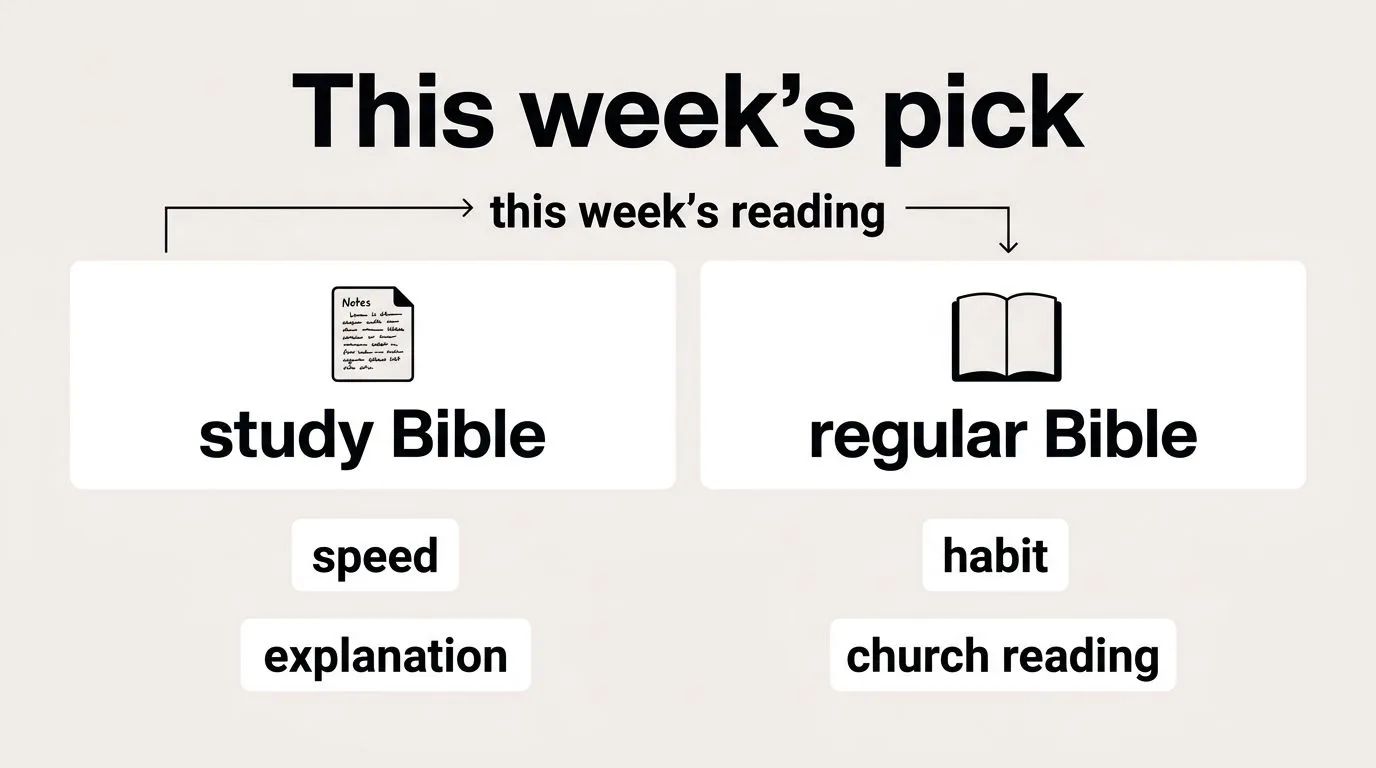
A simple test helps: ask yourself what you need more, speed or explanation. If you want the text to move along in your hands, choose a regular Bible. If you want the page to answer questions as you read, choose a study Bible.
Here’s one practical check: open the sample pages and read the same chapter in two translations, not just a few verses. If the notes help without taking over, the edition is probably a good fit. If the page feels crowded, or one translation is easier to read aloud while still keeping the meaning, keep looking.
Next steps
- Decide your main use, devotional reading, church use, or deeper study.
- Compare two or three translations, especially NIV, NRSV, and CEB, by reading the same passage in each.
- If you want notes, inspect a sample of the study Bible’s pages and check whether the perspective fits your church or convictions.
- Look for beginner-friendly features like maps, timelines, outlines, and a concordance if you want help staying oriented.
- Choose the Bible you will actually open this week, because a good Bible that stays closed helps no one.
Frequently asked questions
Can a beginner use a study Bible, or is it too much information?
Yes, a beginner can absolutely use a study Bible if the notes are clear and the page layout is easy to follow. It becomes too much only when the notes crowd out the biblical text or pull you away from reading. If it helps you understand a hard passage without overwhelming you, it is a good fit.
Should I buy a study Bible in my favorite translation?
Usually yes, if that translation is readable for you and the notes are solid. The article’s test is simple: if you can read the passage naturally and the study helps do not slow you down too much, that translation is a strong choice. Many readers also do well choosing the same translation their church already uses.
Are study Bible notes always trustworthy?
No. Study notes reflect the scholars and publisher behind that edition, so you should check whether the notes fit your theology and whether they point you back to Scripture instead of steering you too hard. A good edition will usually show its sources or at least make its perspective clear.
Do I need a study Bible if I already use a Bible app?
Not necessarily, but a printed study Bible can still be easier for focused reading, highlighting, and slower reflection. Many readers use both, especially if they want the convenience of an app and the calmer, less distracting feel of a printed page. A print edition can also be easier to use when you want the notes right beside the text.


A Letter From Jesus to You
Maybe you arrived here carrying thoughts that no one else knows about. Maybe everything seems fine on the outside, but inside, a battle is taking place. There…

Jesus Has a Word for Your Heart Today
Maybe you arrived here carrying thoughts that no one else knows about. It could be a concern about your family, an important decision, a financial struggle, or…

7 Promises From God for Difficult Times
Seven promises to pray in hard seasons, with clear context so you can trust God’s Word without misreading it.

A Practical Guide to Reading the Gospels
Read one Gospel at a time, keep sessions short, and notice each writer’s purpose so Jesus’ words stay clear.