
Powerful Words of Jesus to Remember Every Day
The words of Jesus are short, clear statements and teachings recorded in the Gospels, and they remain powerful because they were spoken in real moments of healing, conflict, prayer, and promise. To remember them well, read the verse in its Gospel setting first, then apply the main idea to your day, because exact wording and intended meaning are not always the same thing.
Key takeaways
- Read each saying in its Gospel setting first, then apply the main idea to your day, so you do not mistake wording for meaning.
- Use 5 anchor themes, faith, forgiveness, prayer, worry, and love, to keep Jesus’ teaching in daily memory.
- Check the verses before and after the quote every time, because context is what tells you who Jesus is speaking to and why.
- Compare at least 2 trusted Bible translations when a verse feels unclear, especially for short sayings you plan to memorize.
Where the words of Jesus appear in the Gospels
The words of Jesus appear through Matthew, Mark, Luke, and John as part of each Gospel writer’s own account, so the same teaching can be phrased a little differently without changing its core message. That matters because the Gospels are not random quote collections, they are living narratives, and Jesus’ words are always tied to a scene, a listener, and a moment.

You can see that pattern in John 14:6, Matthew 6:33, and Matthew 5:16, three sayings that are easy to memorize but lose force if you pull them away from their setting. John 14:6 comes in a farewell conversation, Matthew 6:33 sits inside teaching about daily need and trust, and Matthew 5:16 belongs to a larger sermon about kingdom life and public witness.
Some sayings are given at the exact moment they were spoken, while others are gathered by theme, especially in sections like Matthew 5-7, the Sermon on the Mount, where Jesus’ teaching is presented in a unified block. Other words appear in scenes of crisis or mercy, including Mark 5:41 and Luke 23:43, which are brief, direct, and unforgettable because they belong to one person’s need at one decisive moment.
That distinction helps you avoid two common mistakes. One is treating a line as a slogan with no context. The other is missing the main idea because you are too focused on whether every Gospel records the same exact wording.
How to read a saying in its original context
Reading a saying of Jesus in context starts with the verses around it, because the surrounding lines tell you what problem Jesus is addressing and what response He expects. Jana Carlson makes this basic point clearly: Scripture was written to a specific group of people, at a specific time, for a specific purpose, and the original audience matters for interpretation Jana Carlson.
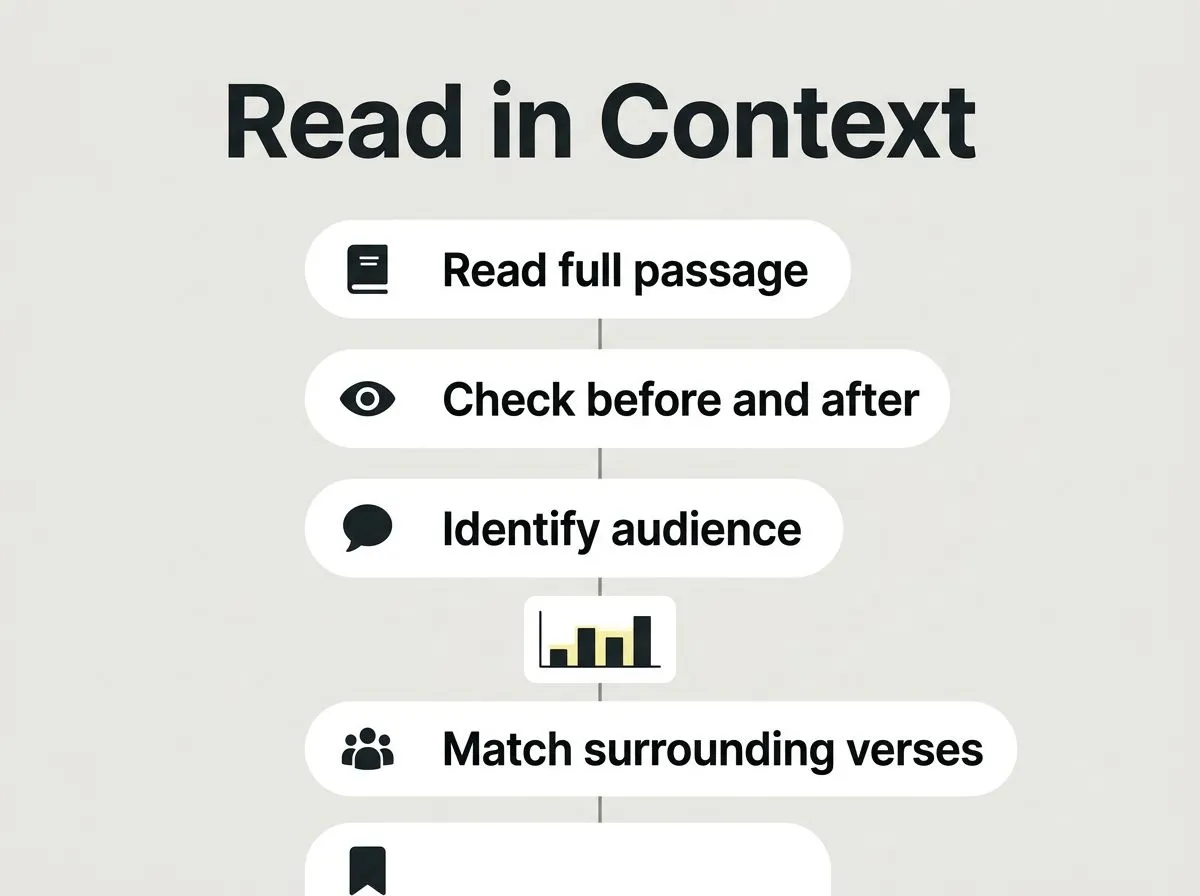
- Read the full passage, not just the highlighted verse, and pay attention to the sentences before and after the quote.
- Identify the audience, whether Jesus is speaking to disciples, a crowd, the Pharisees, or one hurting person.
- Notice the setting, such as a sermon, a healing, a parable, a meal, or a confrontation.
- Ask what question Jesus is answering in that scene, because that usually reveals the meaning of the saying.
- Apply the verse only after you know what it meant there, so you do not make it say more than Jesus intended.
Matthew 16:1-3 shows why this matters, because Jesus answers the Pharisees and Sadducees differently than He would answer a humble seeker. They ask for a sign, but Jesus turns their own ability to read the sky back on them, which means the issue is not lack of information, it is refusal to see what is already before them.
The practical result is simple. When you read in context, you protect yourself from using a verse as a free-floating promise, command, or proof text. You also start hearing the tone of Jesus more accurately, whether He is warning, comforting, correcting, or inviting.
A thematic map of Jesus’ teachings to remember every day
The simplest daily map of Jesus’ teaching is to remember what He says about trust, mercy, prayer, fear, and love, because those themes cover the pressures most readers face before breakfast and after work. Here is a concise way to keep those core sayings in view without flattening them into slogans.
| Theme | Key verses | Daily meaning |
|---|---|---|
| Faith | John 14:1, Matthew 17:20 | Trust Jesus when your strength feels small and your questions feel larger than your control. |
| Forgiveness | Matthew 6:14-15, Luke 23:34 | Release bitterness and keep mercy open, even when the offense feels personal. |
| Prayer | Matthew 6:9-13 | Pray with reverence, dependence, and a willingness to let God lead the day. |
| Worry | Matthew 6:25-34 | Refocus on the Father’s care instead of rehearsing fear over what you cannot carry. |
| Love | Matthew 22:37-39, John 13:34-35 | Let love for God shape how you treat people who are difficult, needy, or easy to ignore. |
This map works because it connects Jesus’ words to actual habits. Faith changes how you face uncertainty. Forgiveness changes how you respond after a sharp conversation. Prayer changes the first minutes of the morning. Worry loses some of its grip when you remember that Jesus speaks directly to anxious hearts, not just to scholars.
The point is not to memorize every verse in this table at once. The point is to let a few anchor sayings return to you often enough that they begin to shape your reactions before the day does.
How to verify the words of Jesus in a Bible translation you trust
Verifying a saying of Jesus means checking the wording in the passage itself, then comparing translations if the line is unclear or familiar enough to be easy to misquote. Logos notes that a translation must communicate clearly to be useful, and it also points out that older English can become hard to understand for modern readers Logos.
- Read the verse in one translation you already trust, then compare it with a second English version if the wording seems different than you expected.
- Open the full chapter, not just the red-letter line, and confirm whether the verse belongs to a longer conversation, sermon, or story.
- Look at study Bible notes, red-letter formatting, and section headings, but treat those as helps, not as the text itself.
- Use trusted reference tools such as Bible Study Tools, BibleProject, and study resources like Logos to compare how the same saying appears across translations and context notes.
- After you confirm both wording and setting, write down the main idea in your own words so you can remember the teaching without flattening it.
That last step matters more than people expect. A line can sound familiar and still be misunderstood if you only remember the phrase and forget the scene. Desiring God notes that the Gospels may preserve Jesus’ words with exact phrases in some places and with the gist in others, which is another reason context has to come before application Desiring God.
If you want a simple rule, use this one: trust the passage before you trust your memory. Then let the wording sharpen your understanding instead of replacing it.
Which tools help without taking over
Bible Study Tools, BibleProject, Logos, Red Letter Study, and The Gospel Coalition are helpful when they point you back to the text instead of away from it. They are useful because they support comparison, context, and careful reading, but they should never become a substitute for the actual words in your Bible.
That is where many readers get tripped up. A red-letter format can make a verse feel more important than the surrounding paragraph, and a study note can feel more certain than the Scripture it comments on. Use the tools, but keep the Bible passage in front of you.
If a verse seems especially memorable, check whether it is standing alone or sitting inside a larger teaching. That small habit prevents a common mistake, using a beautiful sentence in a way Jesus never meant it to be used.
What these words mean for your daily life
The words of Jesus are meant to direct your next step, not just fill your head with familiar phrases. When you return to them in context, you start hearing where He calls you to trust, where He warns you to slow down, and where He invites you to follow Him in ordinary situations.
A good daily habit is to choose one saying, read the whole scene, and then ask a simple question: what would obedience look like today? That might mean praying Matthew 6 with more honesty, keeping Matthew 6:33 in mind before you start worrying about money, or letting Matthew 5:16 shape the way you speak at home or at work.
Over time, this approach helps the Gospels feel less like a scattered set of quotes and more like one coherent voice. You start hearing Jesus the way the first readers did, through stories, commands, promises, and corrections that belong together.
Verification checklist
- The verse is read in its full passage, and the surrounding verses make the speaker, listener, and setting clear.
- A second English translation confirms the wording when the sentence is unfamiliar, disputed, or easy to misquote.
- The chapter context shows whether the saying is part of a sermon, a confrontation, a healing, or a private conversation.
- The main idea is written in your own words, and it matches what Jesus is actually saying in the scene.
- The application fits the passage, meaning you can point to the exact lines that support it without stretching the text.
Frequently asked questions
Why do some Bible editions put the words of Jesus in red?
Red letters are a reading aid, not a different kind of Scripture. They highlight the sayings traditionally attributed to Jesus, but the color does not change their authority or meaning. Read the surrounding passage too, because the Gospels present His words inside a scene, and the context is what keeps a verse from becoming a slogan.
What if two Bible translations wording the same saying differently?
Compare the verse in context, then decide whether the difference is just style or a real shift in meaning. A translation may use different wording because it is aiming for clarity for modern readers, but the point of the saying should still match the larger paragraph. If it still feels unclear, read a second translation and check the full chapter before you settle on an application.
Are all the sayings of Jesus written down verbatim?
Not necessarily word-for-word in every Gospel. The Gospels faithfully preserve Jesus’ teaching, but each writer may present His words with slightly different phrasing, audience emphasis, or literary arrangement, especially when a saying appears in a sermon, a healing scene, or a farewell conversation. What matters most is the meaning in context, not forcing every account to match every word exactly.
Should I memorize short sayings or longer passages of Jesus?
Both help, but longer passages usually protect the meaning better. A short line is easier to remember, while a full paragraph keeps you from pulling the saying away from the audience, setting, and purpose of Jesus’ words. A good pattern is to memorize the short verse and also read the larger scene so you do not misapply it.


The Life of Jesus Christ: From His Birth to Resurrection
See how Matthew, Mark, Luke, and John trace Jesus from birth to the empty tomb, and why the differences matter.

What Jesus Taught About Forgiveness and Second Chances
Jesus ties forgiveness to mercy, repentance, and love for enemies. Learn how His teaching shapes real forgiveness and wise boundaries.

What Jesus Taught About Faith, Trust, and Believing in God
Jesus teaches faith as personal trust in Him. Learn what that means, how it differs from works, and how to live it daily.

What Jesus Taught About Love: Lessons for Everyday Life
Jesus taught love as sacrifice, obedience, and action. Learn how that shapes your words, choices, and relationships each day.