
7 Promises of Jesus to Remember During Difficult Times
When life feels heavy, Jesus doesn’t leave you with slogans. He gives you real promises you can hold onto in fear, grief, waiting, loneliness, and confusion. This guide looks at seven promises of Jesus and keeps each one in context, so you can see who He was speaking to, what He meant, and how that promise still steadies believers today.
Key takeaways
- Jesus’ promises are strongest when read in context, not as isolated lines, so start with the setting before you claim the comfort.
- This guide focuses on 7 promises of Jesus, not every promise in the Bible, so you can compare the passage with your own need.
- For fear or grief, match 1 promise to 1 need this week, then pray it daily instead of trying to hold all 7 at once.
- John 14 gives 3 major comforts at once: Jesus’ peace, His presence, and His return, which makes it a key chapter for hard seasons.
- If you are waiting for direction, focus on Jesus’ promise of presence, because He does not always give the next step, but He does stay with you.
This is not a list of every promise in the Bible. It focuses on places where Jesus speaks directly, or where His promise is clearly extended to His followers, and it keeps each passage tied to its setting. That matters, because a promise pulled out of context can sound comforting while saying something the passage never meant.
Seven Promises of Jesus in Scripture
- The promise of salvation appears in Romans 10:9-10, where the heart of the promise is that confessing Jesus as Lord and believing that God raised Him from the dead leads to salvation. BibleStudyTools places this among the central promises of God, and the plain meaning is simple: your hope is not built on how strong you feel, but on who Jesus is and what God has done in Him.
- The promise of rest and renewal appears in Matthew 11:28-30, where Jesus spoke to those who were weary and burdened. He was addressing people carrying religious pressure and heavy labor, and His invitation means that you do not have to keep proving yourself to earn His welcome.
- The promise of guidance and presence appears in John 14:3 and Matthew 28:20, where Jesus spoke to His disciples on the night before His death and again after His resurrection. SermonCentral highlights John 14:3 as part of Jesus’ return promise, and the comfort here is that He is not only leading you forward, He is with you while you wait.
- The promise of peace and not being abandoned appears in John 14:27 and Hebrews 13:5-6, where Jesus assured His followers that His peace would remain with them and that He would never leave them. Uncommon Pursuit points to Matthew 28:20 and Hebrews 13:5-6 together, which helps you read this as steady presence, not a passing feeling.
- The promise of answered prayer appears in John 14:13-14, where Jesus told His disciples that whatever they ask in His name, He will do, so that the Father may be glorified in the Son. DavidJeremiah.org notes that this is not a blank check for selfish desires, and that warning matters because the promise is tied to Jesus’ honor and the Father’s will.
- The promise of His return and eternal hope appears in John 14:3, where Jesus said He would come again and take His people to be where He is. Crossway explains that Jesus fulfills promises in ways that Scripture had already prepared for, and this promise steadies believers in grief because delay is not the same as absence.
- The promise of the Holy Spirit’s help appears in John 14:16-17, 26, where Jesus said the Father would send another Helper who would be with His disciples forever and help them remember His teaching. DavidJeremiah.org and BibleStudyTools both treat this as one of Jesus’ great promises, and the practical meaning is that you are not left to fight through hardship with only your own strength.
How These Promises Speak to Different Kinds of Hard Times

| Promise or passage | Who Jesus was speaking to | Main comfort in plain language | Best cross-references | What not to assume |
|---|---|---|---|---|
| Romans 10:9-10, salvation | People hearing the gospel and being called to respond in faith | Jesus saves those who believe in Him and confess Him as Lord | John 3:16, Ephesians 2:8-9 | Do not treat salvation as something you earn by religious effort |
| Matthew 11:28-30, rest and renewal | The weary and burdened | Jesus gives rest to people who come to Him | Psalm 23:1-3, Hebrews 4:9-10 | Do not read this as a promise of an easy life |
| John 14:3 and Matthew 28:20, guidance and presence | The disciples facing Jesus’ departure and later His sending mission | Jesus goes ahead of you and stays with you | Deuteronomy 31:6, Hebrews 13:5-6 | Do not assume you will always know the next step clearly |
| John 14:27 and Hebrews 13:5-6, peace and nearness | Followers who were troubled by Jesus’ coming departure | Jesus gives a peace the world cannot manufacture | Philippians 4:6-7, Isaiah 41:10 | Do not expect the absence of feelings before trust takes root |
| John 14:13-14, answered prayer | The disciples learning to pray in His name | Jesus hears prayer that seeks the Father’s glory | 1 John 5:14-15, James 4:15 | Do not turn His name into a formula for getting whatever you want |
| John 14:3, return and eternal hope | The disciples hearing about Jesus’ departure | Jesus will come again and bring His people to Himself | 1 Thessalonians 4:16-18, Revelation 21:3-4 | Do not turn hope into date-setting or speculation |
| John 14:16-17, 26, the Holy Spirit’s help | The disciples who had walked with Jesus and needed continued help | God sends the Helper to strengthen, teach, and remind | Acts 1:8, Romans 8:26 | Do not expect the Spirit’s help to replace obedience or Scripture |
How to Hold Onto Jesus' Promises This Week
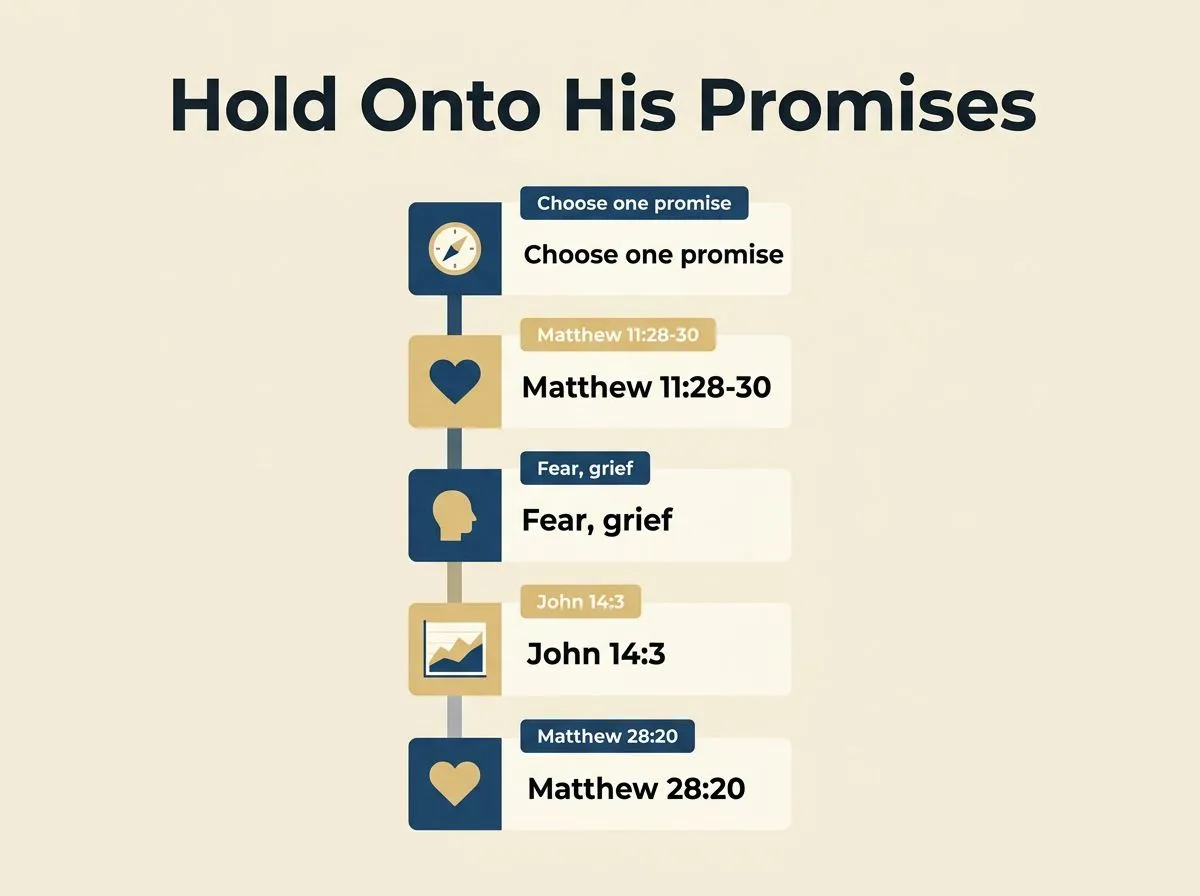
- Choose one promise that matches your need right now, such as fear, grief, loneliness, or waiting. If you are worn down, start with Matthew 11:28-30. If you feel uncertain, start with John 14:3 or Matthew 28:20.
- Read the full passage and one cross-reference aloud so you hear the promise in context. A promise sounds different when you read the whole paragraph, not just the line you already know.
- Pray the promise back to Jesus in your own words. Keep it honest and simple, asking Him to help you trust what He actually said instead of what your feelings say in the moment.
- Write the verse reference where you will see it every day, on a note by your sink, in your phone lock screen, or in a journal page you open during prayer. Small repetition helps the truth stay close when pressure rises.
Jesus’ promises are strongest when you keep them tied to His words, His audience, and His purpose. If you’re in a hard season, don’t go hunting for a verse that flatters your mood. Hold on to the promise that fits your need, read it in context, and let Scripture shape your hope until fear loosens its grip.
Frequently asked questions
Are all of Jesus' promises for every Christian in exactly the same way?
No. Some promises are spoken to the disciples in a specific moment, like John 14:13-14, while others are broader and still steady believers today, such as Jesus’ promise of peace and His presence. The safest approach is to read the passage in context so you do not turn a promise into something it was never meant to guarantee.
Should I read a promise as immediate relief from suffering?
Not always. Some promises meet you with comfort right now, like Jesus’ invitation to the weary in Matthew 11:28-30, but others point to His return, lasting peace, or help from the Holy Spirit. In hard times, the promise may be endurance before relief, and that is still real hope in Christ.
What is the best way to memorize a promise when I feel overwhelmed?
Choose one short verse that fits what you need most, then read it aloud slowly until the words feel familiar. Pairing it with a simple prayer helps, especially if you also write the reference where you will see it during the day, like on your phone lock screen or a note by the sink.
Do I need to read the Old Testament to understand these promises?
Yes, in many cases. The New Testament promise often makes more sense when you see how the Old Testament prepared for it, especially with themes like peace, rest, and God’s presence. Reading the larger biblical context helps you understand what Jesus is fulfilling, extending, or bringing to completion.


The Life of Jesus Christ: From His Birth to Resurrection
See how Matthew, Mark, Luke, and John trace Jesus from birth to the empty tomb, and why the differences matter.

What Jesus Taught About Forgiveness and Second Chances
Jesus ties forgiveness to mercy, repentance, and love for enemies. Learn how His teaching shapes real forgiveness and wise boundaries.

What Jesus Taught About Faith, Trust, and Believing in God
Jesus teaches faith as personal trust in Him. Learn what that means, how it differs from works, and how to live it daily.

What Jesus Taught About Love: Lessons for Everyday Life
Jesus taught love as sacrifice, obedience, and action. Learn how that shapes your words, choices, and relationships each day.