
Why Did Jesus Die for Our Sins? Understanding His Sacrifice
Why did Jesus die for our sins? He died to take our place, bear the guilt of sin, and open the way for forgiveness with God through substitutionary atonement. The Bible presents the cross as both sacrifice and rescue, and the earliest Christians preached it that way even when it sounded shocking, foolish, or offensive.
Key takeaways
- 1 Corinthians 15:3 gives the clearest summary: Christ died for our sins, and the gospel starts there.
- The cross was a public shame in the first century, which is why it shocked both Jewish and Roman audiences.
- Jesus’ sacrifice means substitution, not self-help, so forgiveness comes through faith, not religious effort.
- Repentance still matters after the cross, because forgiveness is meant to restore your relationship with God.
- Christians should explain the cross in plain language: Jesus took our place so sinners can be forgiven and brought back to God.
What the Bible means when it says Jesus died for our sins
The Bible says Jesus died for our sins in plain words: 1 Corinthians 15:3 says Christ died for our sins, Romans 5:8 says He died for us while we were still sinners, Galatians 1:4 says He gave Himself for our sins, and Matthew 26:28 says His blood is poured out for many for the forgiveness of sins. Those verses don’t describe a vague tragedy. They describe a saving act where Jesus stands in the place of sinners.
That is what Christians mean by substitution: Jesus takes the place of sinners so forgiveness can be given justly and truly. We’re saying sin brought real guilt, real separation, and real judgment, and Jesus took on what sinners deserved.
Isaiah 53:6 helps explain this language because it says the Lord laid on Him the iniquity of us all. Early Christians also reached for Deuteronomy 21:23, which speaks of someone hanged on a tree being under a curse, because they saw Jesus’ crucifixion as the place where the curse of sin was borne and dealt with. That’s why the cross was never just a sad ending in the Christian message, it was the heart of it.
Forgiveness in Scripture means God cancels the debt of sin and restores the sinner to Himself. Repentance belongs with that forgiveness because Jesus does not only pardon sin, He calls people to turn from it and trust Him. The cross is where mercy and holiness meet, so the right response is not excuse, but surrender.
Billy Graham Evangelistic Association summarizes this clearly when it says Jesus died in our place and paid the price for our sins fully and completely (Billy Graham Evangelistic Association). That simple phrasing captures the Bible’s core message: Jesus did for sinners what they could not do for themselves.
Why crucifixion mattered in the first century
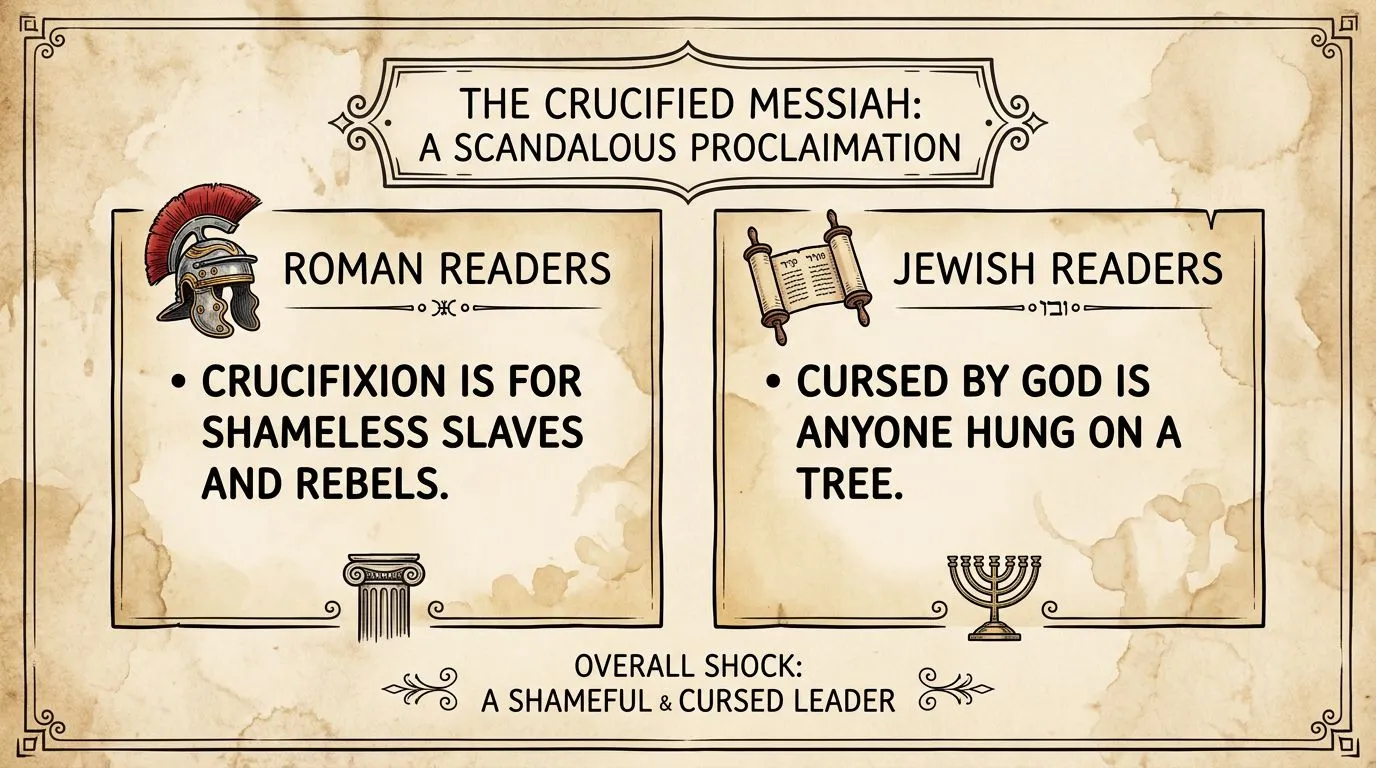
| Group | What crucifixion meant | Why the gospel sounded shocking |
|---|---|---|
| Roman readers | Cruel punishment for criminals and rebellious outsiders | A crucified Messiah sounded weak, shameful, and unheroic |
| Jewish readers | A sign tied to curse language from Deuteronomy | A Messiah under a curse seemed to contradict expectation |
| Early Christians | The place where Jesus bore sin and brought salvation | They preached shameful death as God’s saving act |
Crucifixion mattered because everyone in the first century knew it was public humiliation, not a noble death. The Biblical Archaeology Society notes that Romans used it for criminals and rebellious foreigners, and that it was meant to deter others by making an example of the condemned (Biblical Archaeology Society).
For Jewish readers, the problem was sharper because Deuteronomy 21:23 linked hanging on a tree with being under a curse. That made the claim that Jesus was God’s chosen Savior difficult to hear at first, because the cross looked like proof of rejection rather than proof of victory.
Paul knew that tension, which is why 1 Corinthians 1:23 speaks of preaching a crucified Christ as a stumbling block. The Gospel Coalition explains that the cross offended both Jews and Gentiles because it collided with religious expectation and Greco-Roman ideas of honor (The Gospel Coalition).
That shame is part of the meaning. For Jewish and Roman audiences, crucifixion signaled curse, defeat, and disgrace, so a crucified Messiah sounded wrong before it sounded hopeful. Instead, the cross announced that God saves by bearing shame, not by avoiding it.
What the atonement does, and what “died for our sins” does not mean

- Substitution means Jesus took our place. He did not merely teach about love, He carried the judgment sin deserves so sinners could be forgiven.
- Sacrifice means His death was offered as the cost of dealing with sin. Matthew 26:28 presents His blood as poured out for forgiveness, which shows that the cross is more than a lesson or symbol.
- Reconciliation means the barrier between God and sinners is removed. The goal is not only that you feel better about yourself, but that you are brought back into peace with God.
- The cross does not erase the need for repentance. Jesus’ sacrifice calls you to turn from sin, trust Him, and live as someone bought at a cost.
- Forgiveness is offered by God, but it is received by faith in Christ. You do not earn it by religious effort, and you do not claim it while refusing the Lord who bought it.
- The cross is not only a moral example of love. It is that, but it is also an actual saving act, because Jesus died for sins rather than merely pointing at them.
- A clear way to say the gospel is this: Jesus took our place so sinners could be forgiven and brought back to God.
Moody Church Media emphasizes that Galatians 1:4 links Jesus’ death with deliverance from the present evil world, not just with private guilt (Moody Church Media). That matters because the cross changes both your standing before God and the direction of your life.
Desiring God connects 1 Corinthians 15:3 with Isaiah 53:6 and says Christ bore our sins in His body on the cross (Desiring God). That’s a strong corrective to shallow explanations of the gospel, because it keeps the focus on what Jesus accomplished, not on what we feel about it.
A common mistake is to separate forgiveness from repentance, as if grace means God overlooks sin without changing the sinner. Scripture does not treat repentance as payment for sin, but it does treat repentance as the honest response to mercy. If the cross is real, then sin is serious, and if sin is serious, then turning from it is not optional.
The Gospel Coalition’s discussion of penal substitution says Jesus died in our place as the substitute who bore the penalty for sin so that sinners could be reconciled to God (The Gospel Coalition). That language is direct because the Bible is direct: the gospel is not self-improvement, it is rescue through the death of Christ.
How Christians should explain Jesus’ sacrifice today
You can explain Jesus’ sacrifice by starting with what people already know: guilt is real, forgiveness costs something, and love sometimes means taking another’s burden. Then you bring them to the Bible’s sharper claim, that Jesus bore sin’s burden in your place and opened the door back to God.
Start with the verses that say it most clearly, especially 1 Corinthians 15:3 and Matthew 26:28. Then show how Isaiah 53:6, Romans 5:8, and Galatians 1:4 fit together, so the cross is seen as Scripture’s center rather than a detached religious symbol.
If someone says the cross is only about inspiration, answer gently: inspiration alone cannot remove guilt, and the New Testament presents the cross as more than an example. If someone says repentance is unnecessary, answer just as firmly: the Jesus who forgives also calls sinners to turn and follow Him.
Your next decision is whether you explain the cross as a moral lesson or as saving substitution. The Bible supports the second. You also have to decide whether repentance is a side note or part of the gospel response. Scripture places it together with faith. And your next decision is whether Jesus’ death merely shows love or actually secures forgiveness. The verses in this article point to a real sacrifice with real power.
Frequently asked questions
Does ‘Jesus died for our sins’ mean every sin is automatically forgiven?
No. The New Testament presents Jesus’ death as enough to forgive sin, but that forgiveness is received through repentance and faith, not treated as automatic apart from a response. The article also makes clear that repentance is not a payment for sin, it is the honest response to mercy.
Is this the same as the doctrine of penal substitution?
It overlaps with penal substitution, especially in evangelical teaching, because the article says Jesus took our place and bore the penalty sin deserves. But the Bible’s language is broader too, including sacrifice, rescue, and reconciliation, so the phrase is not limited to one theological label.
Why do some Christians explain the cross differently?
Because the New Testament describes the cross with several images, not just one. The article uses sacrifice, substitution, rescue, ransom-like deliverance, and reconciliation language, while still saying plainly that Jesus bore sin and died for sinners. So different Christians may emphasize different biblical angles without denying the same core truth.
How can I explain this to a new believer in one sentence?
You can say: Jesus took our place on the cross so sinners could be forgiven and brought back to God. That stays close to the article’s simplest faithful summary, and it adds the important point that His sacrifice leads to reconciliation, not just a warmer feeling about faith.


The Life of Jesus Christ: From His Birth to Resurrection
See how Matthew, Mark, Luke, and John trace Jesus from birth to the empty tomb, and why the differences matter.

What Jesus Taught About Forgiveness and Second Chances
Jesus ties forgiveness to mercy, repentance, and love for enemies. Learn how His teaching shapes real forgiveness and wise boundaries.

What Jesus Taught About Faith, Trust, and Believing in God
Jesus teaches faith as personal trust in Him. Learn what that means, how it differs from works, and how to live it daily.

What Jesus Taught About Love: Lessons for Everyday Life
Jesus taught love as sacrifice, obedience, and action. Learn how that shapes your words, choices, and relationships each day.