
What Jesus Taught About Prayer and How We Should Pray
What did Jesus teach about prayer, and how should you pray? He taught that prayer is honest, God-centered, and rooted in trust, not performance. In the Gospels, Jesus warns against praying to impress others, gives the Lord’s Prayer as a model, and shows by His own life that prayer belongs in solitude, pressure, sorrow, and surrender.
Key takeaways
- Jesus warned against performative prayer in Matthew 6:5-8, so sincerity matters more than sounding spiritual.
- The Lord’s Prayer gives 5 priorities, starting with God’s name and ending with deliverance from evil.
- Jesus prayed in solitude, pressure, sorrow, and surrender, which means your prayer life should include every kind of day.
- A prayer can be long or short, but it should stay aligned with God’s kingdom before your own plans.
- Do not treat the Lord’s Prayer as a magic formula, repeat it as an outline for daily prayer instead.
What Jesus Taught About Prayer in the Gospels
Jesus taught that prayer is for the Father’s ear, not for a watching crowd. In Matthew 6:5-8, He warns against public religion that piles up words to sound spiritual. The point is clear: if your prayer is built around being noticed, it has already lost its purpose.

That warning sits inside a larger teaching section, Matthew 6:1-18, and it belongs to the Sermon on the Mount in Matthew 5-7. BibleProject notes that Jesus is challenging worship that performs holiness for approval instead of practicing real dependence on God BibleProject. So Jesus is not discouraging prayer in public, but He is exposing prayer that is aimed at an audience.
Luke 11:1-13 adds another key detail: the disciples see Jesus praying and ask Him to teach them how to pray. That request matters because it frames prayer as something learned from Jesus, not invented by religious instinct. The Lord’s Prayer is therefore a lesson in dependence, starting with God’s name, God’s kingdom, and daily need.
Jesus also connects prayer with the condition of the heart. In Matthew 15:8-9 and Mark 7:6-7, He condemns worship that sounds religious but stays far from God inwardly. That means the words themselves are never the whole point. A prayer can sound polished and still miss the Father if the heart is elsewhere.
The main misreading to avoid is thinking Jesus banned all public prayer or all long prayer. He did neither. His concern is sincerity, not stage management, and His rebuke is aimed at empty display, not at every spoken prayer, every gathered prayer, or every prayer that takes time.
What the Lord’s Prayer Means in Context
| Phrase or petition | What it means in context | What to pray for today | Common misunderstanding to avoid |
|---|---|---|---|
| Our Father in heaven, hallowed be your name | Prayer begins with God’s holiness and fatherly care, not with personal wants | Ask God to be honored in your life, your home, your church, and your choices | Treating prayer as self-focus instead of God-focus |
| Your kingdom come, your will be done | A surrendered request that God’s reign would shape earth as it is in heaven | Pray for obedience, justice, mercy, and alignment with God’s purposes | Using prayer only to ask God to bless your plans |
| Give us this day our daily bread | A daily request for real needs and trusting provision | Ask for what you need today, including work, food, wisdom, and strength | Turning prayer into greed or assuming tomorrow’s needs must be controlled today |
| Forgive us our debts, as we also have forgiven our debtors | Prayer ties repentance to a forgiving spirit toward others | Confess sin honestly and ask God to soften your heart toward those who hurt you | Seeking forgiveness while refusing to forgive |
| Lead us not into temptation, but deliver us from evil | A plea for protection, endurance, and rescue from sin and spiritual harm | Pray for strength when temptation is near and for God’s help in hard moments | Assuming temptation can be handled safely without vigilance |
The Lord’s Prayer is a model for prayer, not a formula that works by repetition alone. Jesus gives it in Matthew 6:9-13 as an outline of right priorities, and BibleProject describes it as part of Matthew 6:1-18, where Jesus trains His listeners away from performative religion and toward real trust BibleProject. The order matters: God’s honor first, then God’s rule, then daily need, forgiveness, and protection.
That order changes how you pray on a normal Tuesday. If you are anxious about rent, work, or a family conflict, you do not begin by trying to force a result. You begin by placing the need inside God’s fatherly care and His kingdom purposes, which keeps prayer from turning into panic with religious language attached.
How Jesus Modeled a Life of Prayer
- Mark 1:35 and Luke 5:16 show Jesus rising early and withdrawing to pray, which teaches the value of quiet time with the Father before the demands of the day begin.
- Luke 22:39-46 shows Jesus praying in Gethsemane with honesty, anguish, and submission, which teaches that faithful prayer can include struggle without losing trust.
- Luke 23:34 and Matthew 27:46 show Jesus praying from the cross, revealing forgiveness, dependence, and real human suffering before God.
- Jesus’ prayer life was not a performance, but a living relationship with the Father that shaped obedience, courage, and compassion.
Jesus prayed in solitude because prayer needs space to be real. Mark 1:35 and Luke 5:16 show a pattern of withdrawal, not because crowds were bad, but because constant noise makes honest prayer harder. The practical lesson is simple: if you never make room for silence, your prayers will usually become rushed summaries instead of fellowship with God.
In Gethsemane, Jesus prayed with full honesty and full surrender. Luke 22:39-46 shows Him wrestling under pressure, yet still yielding to the Father’s will. That scene matters because it shows you do not have to clean up your feelings before you pray. You bring the fear, the grief, and the request, then you entrust the outcome to God.
On the cross, Jesus prayed from the center of suffering. Luke 23:34 shows forgiveness toward His executioners, and Matthew 27:46 shows His cry of abandonment in real anguish. Together, they show that prayer is not only for calm moments. It is also how faith speaks when pain is raw and answers are not immediate.
GotQuestions.org summarizes these examples well by noting that Jesus prayed in Gethsemane, from the cross, and in other decisive moments, which reveals a life shaped by dependence on the Father GotQuestions.org. The pattern matters more than the setting: Jesus prayed because communion with the Father governed His life, not because prayer was a ritual add-on.
How to Apply Jesus’ Teaching Without Misusing It
- Pray honestly and privately, focusing on the Father’s presence rather than on how your words sound to other people.
- Use the Lord’s Prayer as a pattern, then expand each line into your own words, needs, confessions, and praise.
- Pray persistently without turning repetition into a formula, remembering that Jesus teaches trust and dependence rather than magical wording.
- Avoid common mistakes: treating prayer as a spell, skipping forgiveness, and turning Jesus’ private prayer habits into a rigid rule for every situation.
- Let the result be steady, Scripture-shaped prayer that is personal, simple, and directed to the Father through Jesus.
Private prayer helps you become truthful. When you are alone, you are less likely to perform and more likely to admit what is actually happening in your heart. That is why Jesus’ warning in Matthew 6 is so practical, not abstract. He is protecting prayer from becoming a religious costume.
The Lord’s Prayer can guide your own words without trapping you in fixed wording. You can pray, for example, the first line by praising God’s holiness, then move to your workplace, your family, your sins, and the temptations you are facing today. That keeps the prayer alive, while still letting Jesus set the shape.
Persistence matters too. Jesus teaches His followers to keep asking, but not as if repetition can force God’s hand. The difference is decisive: repeated prayer can be an act of trust, while empty repetition becomes noise. The goal is not many words, but steady dependence.
One more caution matters for readers who want to be careful with Scripture. The Lord’s Prayer should not be treated like a spell, and Jesus’ habit of withdrawing to pray should not be turned into a rule that every believer must imitate in the exact same way at every moment. Prayer can be private, corporate, brief, extended, spontaneous, or structured, as long as it remains sincere and God-directed.
What This Means for Your Prayer Life Today
Jesus taught that prayer changes when you stop trying to manage God and start addressing the Father with trust. That means you can pray simply, ask for daily needs, confess sin without pretending, and come back again when fear rises.
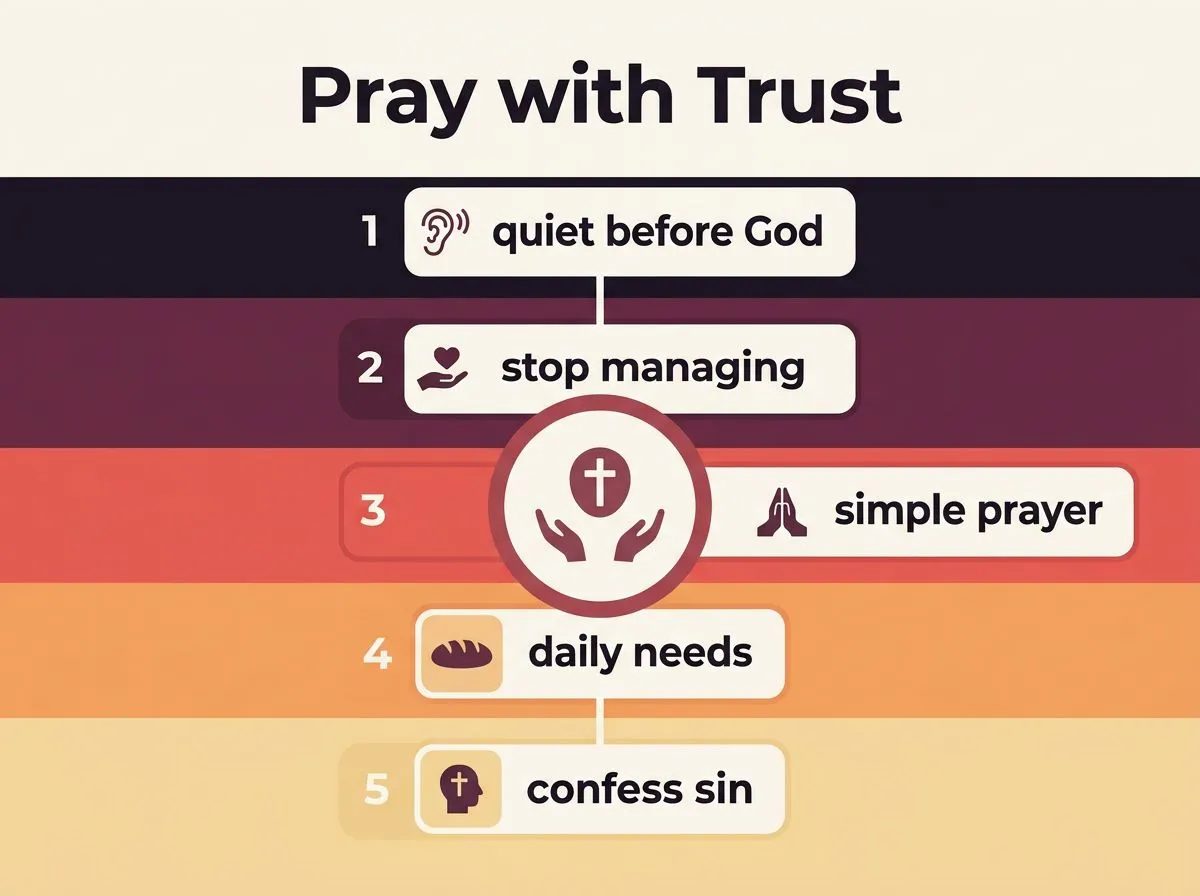
If you want your prayer life to grow, your first decision is where and when you will make room for quiet before God. Your second is whether you will use Jesus’ words as a pattern or as a script. Your third is whether forgiveness and surrender will stay part of your prayers when life is hard.
Frequently asked questions
Did Jesus ever tell people exactly how long to pray?
No. Jesus never gave a required length for prayer. His teaching emphasizes sincerity, trust, and perseverance, not a stopwatch, and He also warned against prayer that drifts into empty repetition or performance.
Is it wrong to use written prayers if Jesus taught a model prayer?
No. Written prayers can help you focus, as long as they are prayed with faith and real meaning instead of being recited mechanically. Jesus gave the Lord’s Prayer as a model, not a magic formula, so the heart matters more than memorized wording.
Should Christians pray only alone because Jesus talked about private prayer?
No. Jesus warned against praying to be seen, but He was not banning prayer in public or with others. The issue is motive, not presence, so gathered prayer is fine when it is sincere and directed to the Father rather than to an audience.
Why did Jesus pray if He was God's Son?
Because His earthly life showed genuine dependence on the Father. His prayers reveal trust, obedience, and communion, and the Gospels show Him praying in solitude, under pressure, in sorrow, and even from the cross. That makes His prayer life a model of real dependence, not weakness.

The Life of Jesus Christ: From His Birth to Resurrection
See how Matthew, Mark, Luke, and John trace Jesus from birth to the empty tomb, and why the differences matter.

What Jesus Taught About Forgiveness and Second Chances
Jesus ties forgiveness to mercy, repentance, and love for enemies. Learn how His teaching shapes real forgiveness and wise boundaries.

What Jesus Taught About Faith, Trust, and Believing in God
Jesus teaches faith as personal trust in Him. Learn what that means, how it differs from works, and how to live it daily.

What Jesus Taught About Love: Lessons for Everyday Life
Jesus taught love as sacrifice, obedience, and action. Learn how that shapes your words, choices, and relationships each day.