
Why So Many People Turn to This Psalm When They Need Protection
Psalm 91 stands out because it gives anxious readers a clear place to rest: God is shelter, fortress, and refuge.

A Powerful Prayer for Family Pray for Your Family’s Protection
READ PRAYER →
You will remain on the same website.
That’s why so many Christians turn to it when they’re praying for a safe trip, steady nerves, or spiritual covering. It’s also worth reading it as Scripture, not as a charm.
Key takeaways
- Psalm 91 is often read as a protection prayer, but it should be read as Scripture, not as a charm.
- The psalm uses several protection images together, shelter, fortress, refuge, and rescue, to strengthen trust.
- Its original setting matters, because the words were written as a prayer of confidence, not a guarantee that nothing hard will happen.
- A faithful reading keeps both spiritual and physical protection in view, instead of forcing only one meaning.
- A better first response is to pray Psalm 91 in context, then pair it with wisdom, obedience, and daily trust.
Psalm 91 Is the Bible Passage Most People Reach For When They Want Protection
Psalm 91 is the best-known Bible passage for God’s protection because its opening lines are hard to forget: dwelling in the shelter of the Most High and abiding under the shadow of the Almighty.
Those words feel personal, immediate, and strong, which is exactly why they stay with people when fear sets in.

The psalm gives readers a whole set of protection words, not just one image. It speaks of refuge, fortress, shelter, trust, rescue, and closeness to God, so the prayer feels layered instead of vague.
When someone is scared, that kind of language gives them something concrete to hold onto.
Other protection passages support the same theme, but they don’t replace Psalm 91. Bible Study Tools highlights verses such as Deuteronomy 31:6, Isaiah 41:10, and Psalm 34:7, all of which point to God’s presence and help.
Psalm 91 is the passage many people remember first because it gathers those ideas into one sustained prayer.
What Psalm 91 Meant in Its Original Biblical Setting
Psalm 91 belongs to the Book of Psalms, a collection of 150 ancient Hebrew poems, songs, and prayers that come from different eras in Israel’s history.
BibleProject notes that this collection includes material from David, Asaph, the sons of Korah, and other worship leaders, which matters because Psalm 91 should be heard as part of a living prayer book, not as a detached promise card.
In that setting, Psalm 91 uses the language of trust and divine refuge, not superstition.
Working Preacher emphasizes that psalms need to be read in their ancient context before they are carried into later faith use, and that helps here, the psalm is expressing confidence in God’s care, not trying to control God with words.
Jewish and Christian readers have long heard the psalm that way. Its images, shelter, wings, shield, and rescue, all belong to a biblical pattern where God protects, guides, and stays near His people.
The power of the psalm is that it turns fear into prayer without pretending fear is unreal.
How Scripture Speaks About Protection, Spiritually and Physically
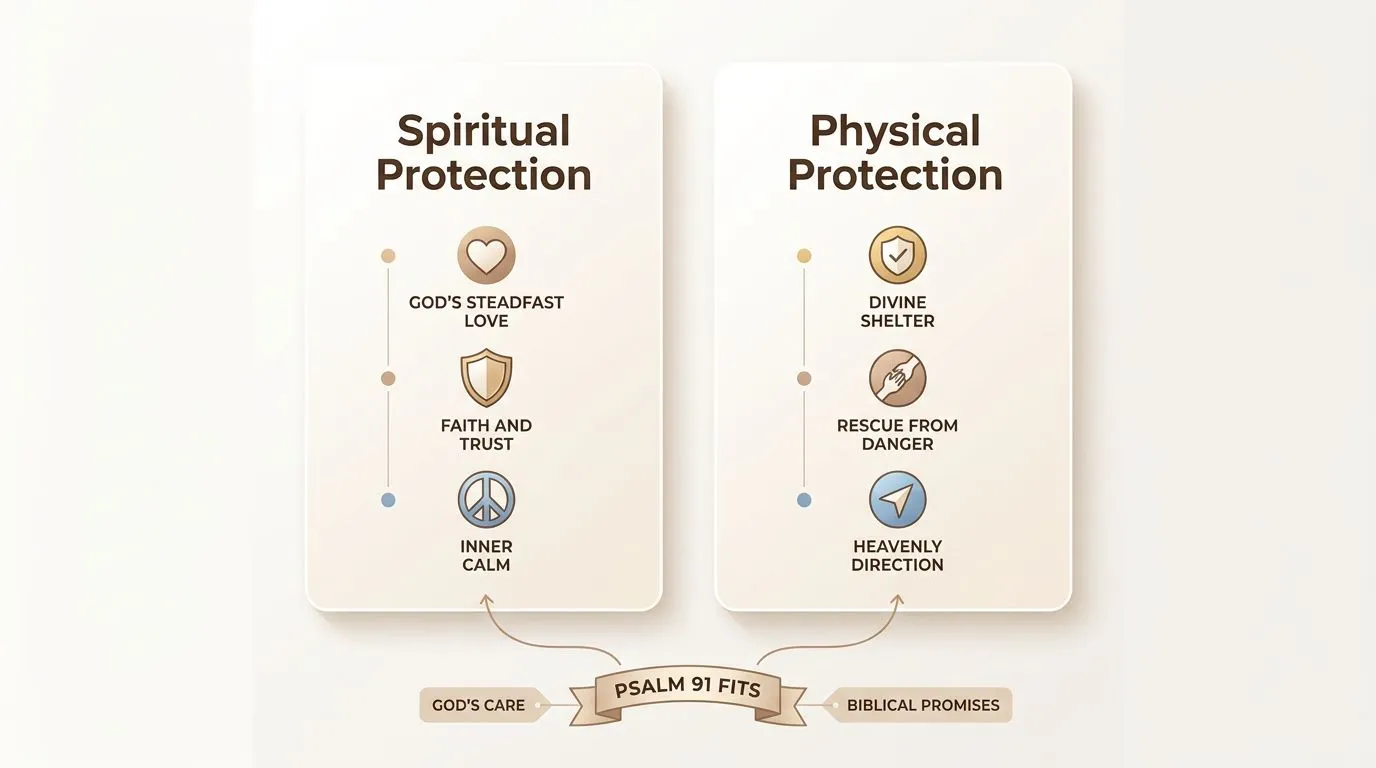
| Protection type | What it emphasizes | Typical biblical language | How Psalm 91 fits | Best use in prayer and reflection |
|---|---|---|---|---|
| Spiritual protection | God guarding the heart, mind, and faith from fear, deception, and evil | Refuge, shield, deliverance, hiding, peace | Psalm 91 speaks strongly here through trust, shelter, and deliverance language | Use it when you need reassurance, courage, and steady faith |
| Physical safety | God’s care in danger, travel, illness, conflict, or daily threats | Safety, rescue, preservation, help, covering | Psalm 91 includes vivid language of danger and rescue, which many readers bring into prayers for protection | Use it when you are asking God for protection in real-life circumstances |
| Whole-life protection | God’s faithful presence across suffering, uncertainty, and ordinary life | Dwelling, abiding, not fearing, being with you | Psalm 91 is often read this way because it centers on God’s presence more than on control over outcomes | Use it as a daily prayer of trust, not a demand for a pain-free life |
This distinction matters because Psalm 91 is often read too narrowly. Some readers hear only physical safety and then feel confused when life includes sickness, loss, or danger.
Others hear only inward comfort and miss the psalm’s very real language of rescue from threats.
Cru’s teaching on Ephesians 6:10-18 helps with that balance by showing that Scripture speaks of spiritual warfare with armor, righteousness, and the sword of the Spirit.
That doesn’t cancel Psalm 91; it shows that biblical protection can include both the unseen battle and the concrete pressures of everyday life.
How Jewish and Christian Traditions Read Psalm 91 Without Twisting It
- Jewish and Christian readers have commonly treated Psalm 91 as a song of trust in God’s care, not as a guarantee that no painful thing will ever happen.
- Many Christians pray Psalm 91 devotionally, sometimes daily, as a confession that God is present and protective in ordinary life and in danger.
- The practical takeaway is simple: Psalm 91 invites confidence in God’s presence while still leaving room for wisdom, obedience, suffering, and hope.
That reading keeps the psalm from becoming a magic formula. If someone treats it like a spoken shield that forces every outcome, they miss the point of the poetry and put pressure on the text that it was never meant to carry. The psalm is stronger than that, because it forms trust instead of superstition.
This is also where traditional devotional use has real value. Psalm91.com notes that many Christians and Catholics pray Psalm 91 in the morning or evening, and that habit makes sense as a steady act of faith.
Read that way, the psalm becomes a daily way to place your fear under God’s care, not a shortcut around reality.
Which protection verse should you reach for first?
Psalm 91 is usually the first choice when you want a full prayer of protection, while Psalm 121 is often the clearest companion when you want a short confession that your help comes from the Lord.
Psalm 34:7 is especially brief and memorable, and it works well when you want a single line to pray in the middle of a hard day.
If you want a broader protection passage, Psalm 91 gives you the richest language. If you want a verse to memorize quickly, Psalm 34:7 may be easier to keep on your lips.
If you want a doorway into trusting God for help on the road, at home, or in a frightening season, Psalm 121 fits naturally beside both.
GotQuestions and Bible Study Tools both group these passages together under the theme of God’s protection, which shows that readers are not wrong to compare them.
The better question is not which verse is better in every case, but which one speaks most clearly to the need right in front of you.
How to pray Psalm 91 in a faithful way today
You pray Psalm 91 faithfully by asking God for protection with trust, not control.
The psalm works best when you read it slowly, notice the repeated images of shelter and refuge, and then turn those words into your own prayer for your family, your travel, your work, or your fears.
A helpful way to use it is simple: read one section, pause, and name what kind of protection you need. That might be peace before surgery, wisdom in a dangerous situation, courage in a new job, or protection from temptations that wear down your faith.
The psalm gives language for all of that without flattening any of it into a formula.
When you pray it this way, Psalm 91 becomes what it was always meant to be: a confession that God is near, strong, and faithful.
The words are not weak because they are ancient. They are enduring because they tell you where real safety begins.
Frequently asked questions
Should I pray Psalm 91 every day?
Yes, many believers do, and the article notes that some Christians pray it in the morning or evening as a steady act of faith.
Read it slowly, thank God for His care, and pray it as a confession of trust rather than as a formula. That keeps it rooted in devotion, not superstition.
Is Psalm 91 only for emergencies?
No. It is also for steady, everyday faith, especially when fear, uncertainty, or spiritual pressure is wearing you down.
The article presents it as a prayer you can use for ordinary life, not only for crisis moments, because it centers on God’s shelter and nearness.
Does Psalm 91 promise that nothing bad will ever happen?
No. It promises God’s protection and nearness, but Scripture does not turn that into a blank check against every hardship.
The article is careful to say Psalm 91 invites confidence in God’s presence while still leaving room for wisdom, suffering, and hope.
What Bible verse is best if I want protection and courage?
Deuteronomy 31:6 and Isaiah 41:10 are strong choices because they join God’s presence with courage, strength, and reassurance.
The article also points to Psalm 121 and Psalm 34:7 as helpful companions, but Psalm 91 gives the fullest prayer when you want a broader expression of protection.


This Bible Verse Can Help You Face a Difficult Day
Psalm 46:1 is a strong Bible verse for a difficult day because it says, “ God is our refuge and strength , a very present help in trouble.” Put simply, God is…

Before Your Next Important Decision, Remember What Proverbs Says
A common mistake is treating Proverbs like a magic formula that guarantees the outcome you want if you quote the right verse. The better way is simpler, and st…

Read This Bible Verse When You're Worried About Your Future
If you’re worried about your future, start with Jeremiah 29:11. It reminds you that God knows your life, sees what you can’t see, and is still working with pur…

This Bible Verse Is a Powerful Reminder of God's Promises
Jeremiah 29:11 is one of the clearest Bible verses about God’s promises: “For I know the plans I have for you, declares the Lord, plans for welfare and not for…