
Read This Bible Verse When You're Worried About Your Future
If you’re worried about your future, start with Jeremiah 29:11. It reminds you that God knows your life, sees what you can’t see, and is still working with purpose, hope, and good plans, even when today feels unclear.

Prayer for a Secure Future Trust God with what comes next.
READ PRAYER →
You will remain on the same website.
Key takeaways
- Jeremiah 29:11 is the best first verse to read when future worry feels overwhelming, because it points you back to God’s plans, not your fears.
- Read Jeremiah 29:10-14 with Jeremiah 29:11 so you keep the promise inside its original context, including prayer and waiting.
- Use Matthew 6:34 for the next 24 hours, not the next 24 months, and let it interrupt the habit of borrowing tomorrow’s trouble.
- Write down 1 next faithful step, like a phone call or a document to gather, so trust in God leads to action instead of paralysis.
- If your fear is really about being alone, pair Jeremiah 29:11 with Romans 8:38-39 or 1 Peter 5:7 for stronger reassurance.
The Bible verse to read first when you are worried about the future
Jeremiah 29:11 is the verse to open when tomorrow feels heavy: “For I know the plans I have for you,” declares the Lord, “plans to prosper you and not to harm you, plans to give you hope and a future.”
In plain English, God is not random, and your life isn’t drifting without direction.

This verse does not promise instant comfort or total control. It promises that God’s plans are real, His heart is for your good, and your future is not out of His hands, even when your emotions say otherwise.
That is why it speaks so directly to fear about the future. When you don’t know what comes next with work, family, health, school, or money, Jeremiah 29:11 gives you something firmer than a guess: God already knows the plans.
A simple prayer paraphrase you can use is this: “Lord, I trust that You know my future and that Your plans for me are good.”
If writing helps, put it in a journal and pray it slowly before you start making decisions.
What Jeremiah 29:11 meant in context, and which related Bible verses belong beside it
| Passage | Original context | Main message | How it speaks to future worry | Best use for a worried reader |
|---|---|---|---|---|
| Jeremiah 29:11 | God spoke to His people in exile, not to people living in easy circumstances. | God’s plans are purposeful, and hope is still coming. | Your future is not abandoned, even if the present is painful. | Use it when you need confidence that God has not forgotten you. |
| Jeremiah 29:10-14 | The promise sits inside a longer message about a set season, prayer, and seeking God. | God calls His people to seek Him and trust His timing. | The verse is strongest when you remember that hope includes waiting and prayer. | Read the whole passage when you are tempted to isolate the promise from the process. |
| Matthew 6:34 | Jesus is teaching about daily dependence, not panic about next month. | Do not borrow trouble from tomorrow. | This verse addresses the habit of rehearsing future fears before they arrive. | Use it at bedtime or when your mind keeps jumping ahead. |
| Philippians 1:6 | Paul writes with confidence to believers that God finishes what He starts. | God will carry His work to completion. | Your growth is not a lost cause, and your future is still under His care. | Use it when you feel spiritually unfinished or unsure whether you will make it. |
| Romans 8:38-39 | Paul lists every force that cannot separate believers from God’s love. | God’s love in Christ is unbreakable. | Even the worst-case scenario cannot cut you off from Him. | Use it when fear is really about being alone, not just being uncertain. |
| 1 Peter 5:7 | Peter tells believers to cast their anxieties on God because He cares. | God welcomes your burdens instead of asking you to carry them alone. | Future worry becomes lighter when you hand it to the One who cares for you. | Use it in prayer when your anxiety feels too personal to say out loud. |
Jeremiah 29:11 is not a floating promise, it belongs to a people living through exile, and that context matters.
The comfort comes from God’s faithful character, not from the idea that every believer will get immediate relief on their preferred timetable, a point also emphasized in Bible Study Tools.
Matthew 6:34 and James 4:13-17 push in the same direction from different angles. Jesus tells you to stop living in tomorrow before tomorrow arrives, while James reminds you that even the best business plan is still subject to the Lord’s will.
Philippians 1:6 helps when you’re afraid that your life is still too messy for God to use.
Romans 8:38-39 helps when the deeper fear is loss of love, loss of belonging, or being separated from God by whatever comes next.
1 Peter 5:7 is the verse to pray when the feeling itself is the burden. It gives you permission to name the anxiety, hand it over, and stop acting as if carrying it alone were a sign of faith.
How to trust God with your future without ignoring real life responsibilities
- Pray Jeremiah 29:11 slowly, then pause and name the specific future you are afraid of. A vague prayer stays vague; a clear prayer turns fear into a request.
- Write down the next faithful step, not the whole life plan. If you need to update a résumé, make a phone call, or gather documents, do that one thing instead of trying to solve five years at once.
- Use James 4:13-17 to check your attitude before you commit to a plan. Planning is wise, but planning that leaves no room for God becomes a quiet form of control.
- Keep Matthew 6:34 for the moment your mind jumps ahead. Ask, 'What does obedience look like today?' and do that before you try to live next week.
- Hold Philippians 1:6 when your progress feels slow. God can be working while your circumstances are still unfinished, so do not confuse delay with abandonment.
- Return to Romans 8:38-39 and 1 Peter 5:7 when your fear becomes personal. One verse steadies your identity, and the other gives your anxiety somewhere to go.
Faithful planning and anxious control are not the same thing
Faithful planning looks like preparing a budget, making the appointment, or applying on time.
Anxious control looks like believing that if you just think hard enough, you can force the future to behave.
Billy Graham made this distinction plainly: planning and worrying are different, and worrying is not trust.
That matters because some readers feel guilty for preparing at all, when the real issue is not preparation but fear-driven obsession with outcomes Billy Graham.
If a decision is already in front of you, plan it. If the outcome is outside your reach, release it.
That is the practical line many believers miss, and it’s usually where peace starts to return.
What to do when your thoughts keep spinning at night
When your mind won’t stop, move from silence to speech by praying one sentence at a time.
Esther Press gives a very practical pattern for this kind of night fear: write the promise down, speak it out loud, and let it replace the anxious loop Esther Press.
You can also keep a short set of verses near your bed or on your phone notes, and choose one before sleep.
American Bible Society and David Jeremiah Blog both point readers toward Scripture as a steadying practice, especially when fear grows louder than reason American Bible Society and David Jeremiah Blog.
The goal is not to force an emotion in one minute. The goal is to stop feeding the fear and start feeding faith with words you can actually pray.
A short prayer you can use today
Lord, I give You my future, my plans, and the things I cannot control. Help me trust Your timing, obey You today, and rest in Your care for me.
That prayer is small enough to say on a hard morning and honest enough to say on a sleepless night. If you need more words, start with Jeremiah 29:11 and end with 1 Peter 5:7.
Verification checklist for a worried heart
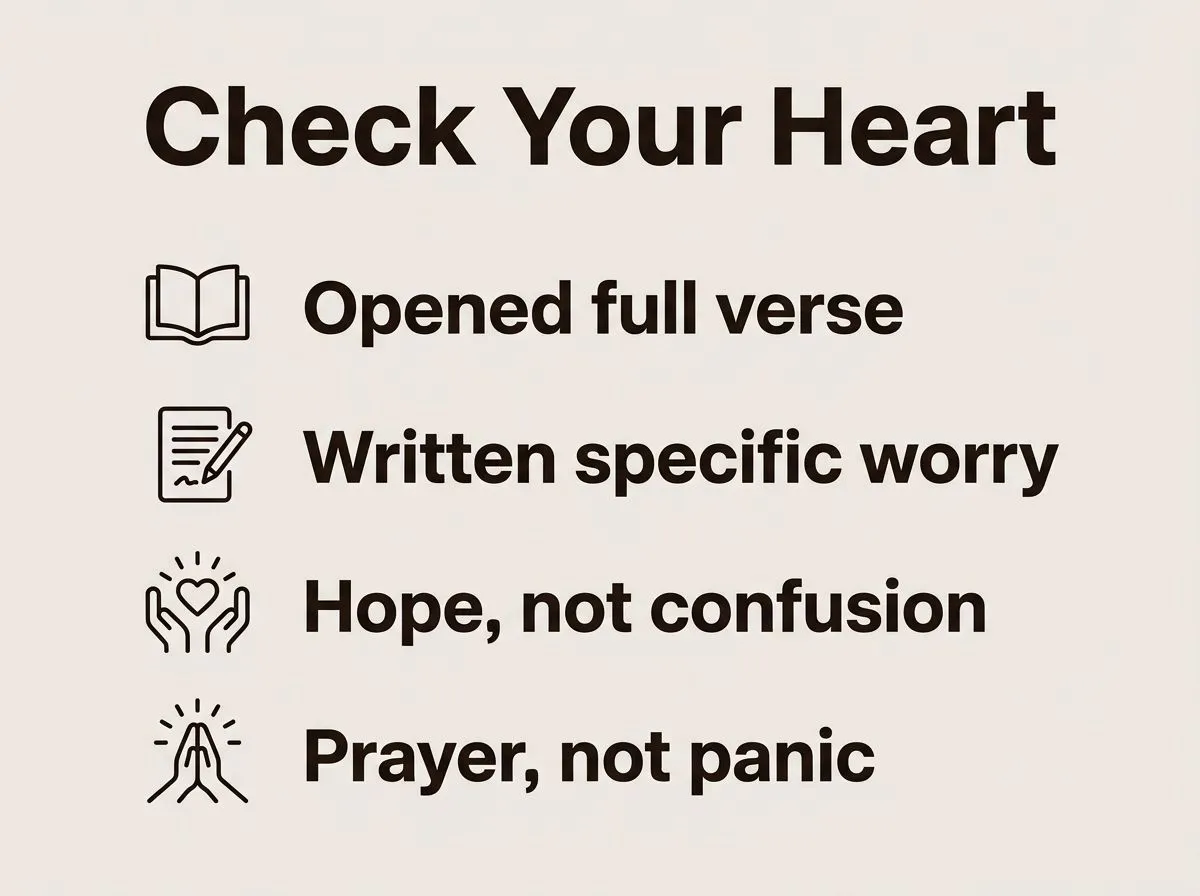
- You have opened Jeremiah 29:11 and read it in full, not just a fragment, and the verse leaves you with hope instead of confusion.
- You have written one specific future worry in plain language, and it is narrow enough to pray about without turning into a general panic.
- You have identified one next responsible action, and you can complete it today without waiting for total certainty.
- You have chosen one verse for nighttime worry, and it is saved where you can reach it before your thoughts start spiraling.
- You have turned the outcome over to God in prayer, and your words make clear that you are asking for trust, not pretending everything feels easy.
Frequently asked questions
Is Jeremiah 29:11 only for Israel, or can Christians pray it today?
Its original promise was spoken to God’s people in exile, so the context matters.
Still, Christians can pray it today because it reveals God’s faithful character, His purposeful plans, and the hope He gives when life feels uncertain.
The promise is strongest when you remember that hope may come through waiting, prayer, and trust in His timing.
What verse should I read if I am afraid about tomorrow at night?
Matthew 6:34 is a strong verse to read at night because Jesus speaks directly about not borrowing trouble from tomorrow.
It fits especially well when your mind keeps jumping ahead after the day is over. If you want a companion verse, 1 Peter 5:7 helps you hand the anxiety to God in prayer.
How do I know whether I am planning wisely or worrying too much?
Planning names a next step you can actually take, while worry keeps replaying outcomes you cannot control.
A good test is this: if your thoughts are spinning but not producing obedient action, you are likely carrying anxiety rather than wise preparation.
James 4:13-17 also helps you check whether your plans still leave room for the Lord’s will.
Should I pray only one verse, or several verses together?
One verse can be enough if it helps you pray with faith and clarity. Jeremiah 29:11 on its own may steady you, but pairing it with Matthew 6:34 or 1 Peter 5:7 can give you a fuller picture of God’s care, daily dependence, and the way to hand Him your anxiety.


This Bible Verse Can Help You Face a Difficult Day
Psalm 46:1 is a strong Bible verse for a difficult day because it says, “ God is our refuge and strength , a very present help in trouble.” Put simply, God is…

Before Your Next Important Decision, Remember What Proverbs Says
A common mistake is treating Proverbs like a magic formula that guarantees the outcome you want if you quote the right verse. The better way is simpler, and st…

This Bible Verse Is a Powerful Reminder of God's Promises
Jeremiah 29:11 is one of the clearest Bible verses about God’s promises: “For I know the plans I have for you, declares the Lord, plans for welfare and not for…
Why So Many People Turn to This Psalm When They Need Protection
Psalm 91 stands out because it gives anxious readers a clear place to rest: God is shelter, fortress, and refuge. That’s why so many Christians turn to it when…