
Worried About Money? Jesus Spoke About This Very Concern
The common mistake is to think Jesus told worried people to ignore real bills and act like money doesn’t matter.

Prayer for Debt Relief and Prosperity Pray for Financial Relief
READ PRAYER →
You will remain on the same website.
He did the opposite. He named food and clothing, then called His disciples to trust the Father instead of letting fear run their finances.
Key takeaways
- Matthew 6:25-34 names 3 daily needs, food, drink, and clothing, then calls you to seek God’s kingdom first.
- Jesus’ warning in Matthew 6:24 gives you a clear decision: money cannot be your master and your security at the same time.
- The article’s practical test is simple, before your next purchase, ask whether it comes from wisdom, trust, or fear.
- A wise response to money stress has 2 parts, pray honestly about today’s need and choose one concrete action this week.
- Contentment, greed, and stewardship are not abstract ideas, they show up in how you save, give, and say no to excess.
What Jesus said about money, worry, and God’s care
Jesus told His disciples not to worry about daily needs because the Father already knows what they need.
In Matthew 6:25-34, He points to food and clothing, then says life is more than those things. In Matthew 6:24, He warns that no one can serve both God and money.
Luke 12:22-34 says the same thing in a parallel passage and ends with the call to seek God’s kingdom first.

That context matters. Jesus is not promising wealth, luxury, or a life free from expense.
He is teaching people who still need to eat and dress. The issue is not only the size of the bank account, but the fear that money will become the master of the heart.
The point is practical. Worry pulls your attention into tomorrow and makes every need feel like a threat, while Jesus turns the disciple back to the Father’s care, one day at a time.
That is why the passage speaks so directly to financial anxiety, it addresses the inner pressure behind overspending, panic saving, and desperate striving.
How a Bible verse about money shapes real financial choices
- Spending: ask whether a purchase reflects wisdom, trust, or fear.
- Saving: planning for needs can be wise when it is not driven by hoarding or panic.
- Giving: generosity is a way to show open-handed trust in God’s provision.
- Contentment: Scripture helps you name what you truly need versus what you only want.
- Practical check: examine motives, not just balances, because the heart often reveals the real story.
Contentment, greed, and stewardship in Scripture
| Heart posture | What it looks like in daily life | Biblical warning or example | Financial result or habit |
|---|---|---|---|
| Contentment | You can say no to upgrades you do not need and still feel steady | Hebrews 13:5 calls you to be content with what you have; Bible Study Tools highlights this verse alongside Jesus’ teaching | You spend with peace instead of chasing status |
| Greed | You keep adding because enough never feels like enough | Jesus warns in Matthew 6:24 that money can compete with God; Mark 12:41-44 shows the contrast between large gifts and a poor widow’s small offering | You may hold too tightly, give reluctantly, or justify debt for image |
| Stewardship | You treat resources as something entrusted, not owned absolutely | Matthew 19:21 calls one rich man to sell and give to the poor, while Luke 6:38 connects generosity with measure and return | You make intentional choices about saving, giving, and restraint |
| Fear-driven control | You stockpile or restrict every dollar because loss feels unbearable | Luke 12:22-34 confronts anxious control and directs the heart toward the kingdom | You may look organized on paper but still live tense and reactive |
How to pray and act when money stress feels heavy
Read Matthew 6:25-34 slowly, then name one real spending choice in front of you, such as whether to delay a nonessential purchase so you can cover rent or groceries first.
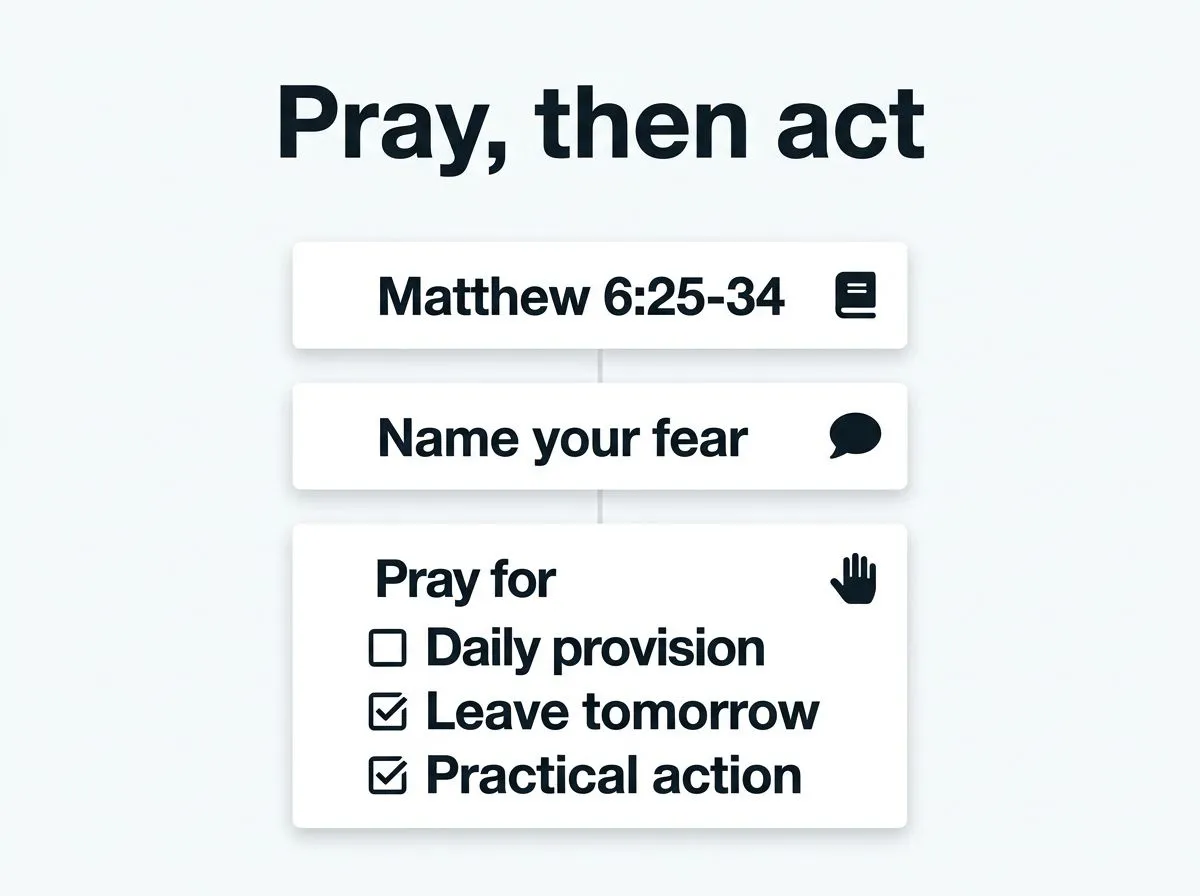
- Pray for daily provision instead of asking for control over the future. Ask God for what you need today, and leave tomorrow in His hands.
- Choose one practical action, such as trimming a purchase, starting a savings goal, or giving generously. Keep it concrete enough to do this week.
- Return to the passage when fear rises, and measure the choice in front of you against trust in God rather than impulse.
- Use a trusted Bible reading tool, such as Bible Gateway or Amazing Facts, to read the verses in context, and compare that with a study note from Envoy Financial if you want a stewardship angle.
What to verify before you make your next money decision
- The verse you are using must be read in context, and the passage should clearly match the issue you are facing, not just the word money.
- The next purchase, transfer, or gift should have a clear reason, and that reason should sound like trust, wisdom, or generosity, not panic.
- Your budget should show one concrete action that matches your prayer, such as a reduced expense, a set savings amount, or a planned gift.
- Your heart should be able to name what it wants, and the answer should be honest enough to distinguish contentment from craving.
Jesus did not call you to deny real needs, and He did not teach that money will never be tight. He called you to live as someone the Father knows, sees, and provides for. That changes the way you spend, save, and give when pressure starts speaking loudly.
Frequently asked questions
What is the best Bible verse for money stress?
Matthew 6:25-34 is the strongest starting point because Jesus directly addresses worry about food, clothing, and tomorrow.
Matthew 6:24 adds an important warning, money can compete for your loyalty, so the passage speaks to both the practical pressure and the heart behind it.
Does Jesus tell Christians not to save money?
No. Jesus warns against anxious hoarding, not wise planning. Saving can be an act of stewardship when it is done with trust instead of fear, but the warning in the passage is against letting tomorrow control your heart.
Is tithing the same as generosity in the New Testament?
Tithing and generosity overlap, but they are not the same thing. The New Testament emphasis is broader, open-handed giving that reflects a willing heart, and passages like Mark 12:41-44 show that faithfulness is not measured only by an amount.
How do I know if I am being content or just giving up?
Contentment accepts God’s care while still taking responsible action. If you are still making wise choices, adjusting your spending, and obeying without panic, that is contentment, not giving up. Giving up ignores wisdom and stops acting altogether.
What verse warns against loving money too much?
Hebrews 13:5 warns against the love of money and points you back to contentment with God’s presence.
Matthew 6:24 says the same concern in Jesus’ words, showing that money becomes dangerous when it starts competing for first place in your heart.


This Bible Verse Can Help You Face a Difficult Day
Psalm 46:1 is a strong Bible verse for a difficult day because it says, “ God is our refuge and strength , a very present help in trouble.” Put simply, God is…

Before Your Next Important Decision, Remember What Proverbs Says
A common mistake is treating Proverbs like a magic formula that guarantees the outcome you want if you quote the right verse. The better way is simpler, and st…

Read This Bible Verse When You're Worried About Your Future
If you’re worried about your future, start with Jeremiah 29:11. It reminds you that God knows your life, sees what you can’t see, and is still working with pur…

This Bible Verse Is a Powerful Reminder of God's Promises
Jeremiah 29:11 is one of the clearest Bible verses about God’s promises: “For I know the plans I have for you, declares the Lord, plans for welfare and not for…