
Prayer for Anxiety: Find Peace and Comfort in God
Anxiety is not the same as ordinary worry that comes and goes, and prayer is not a magic switch that wipes out every symptom at once. The right response is honest prayer, steady Scripture, and wise care when anxiety starts affecting your sleep, work, relationships, or peace.
Key takeaways
- Use 1 prayer now: tell God the fear plainly, then pray Philippians 4:6-7 over your mind.
- If anxiety keeps returning for months or disrupts sleep, work, or relationships, do not treat it as simple stress.
- Pray short Scripture lines during the day, especially before bed, during travel, or before a hard conversation.
- Seek professional help as soon as anxiety starts changing your choices or shrinking your daily life.
What anxiety is, and how to recognize it
Anxiety is ongoing fear or apprehension about what may happen next, and it can show up in your body, thoughts, and everyday choices. The American Psychological Association describes it as a future-oriented response to a perceived threat, while the World Health Organization says it can include worry, restlessness, trouble concentrating, a racing heart, sweating, trembling, and a sense of impending doom American Psychological Association, World Health Organization.
You may feel it in your body as a tight chest, a fast heartbeat, muscle tension, stomach upset, or trouble sleeping. Mentally, it can show up as constant fear, racing thoughts, irritability, or trouble making decisions. You may also notice it in your behavior, especially when you start avoiding places, conversations, or responsibilities that trigger fear.
A stressful season can leave you tired and tense for a while. Anxiety becomes more concerning when the symptoms keep coming back, last for months, or start interfering with normal life, which is how the WHO and NIH MedlinePlus Magazine describe many anxiety disorders NIH MedlinePlus Magazine.
That difference matters. If you are simply under pressure, prayer, rest, and practical support may help you recover. If fear is starting to steer your decisions or shrink your life, you may be dealing with more than passing worry.
A prayer for anxiety rooted in Scripture
Start by telling God the truth about what you fear, because hiding it only leaves you alone with it. Scripture gives you language for surrender, peace, and trust, and you can pray those words even when your own words feel thin.

- Name the fear plainly before God. Say what is happening in your mind, body, or life instead of trying to sound strong.
- Pray from Philippians 4:6-7 by bringing your requests to God with thanksgiving, asking Him to guard your heart and mind with His peace.
- Cast your cares on Him from 1 Peter 5:7, because He cares for you and does not ask you to carry fear by yourself.
- Use Psalm 56:3 when fear rises fast: when you are afraid, put your trust in God instead of rehearsing the worst case.
- Rest in Psalm 46:10 by pausing long enough to remember that God is God, and you do not have to control every outcome.
You can pray this now: Lord, I bring You my anxiety, my fear, and the thoughts I cannot quiet. I choose to trust You with what I cannot fix. Guard my heart and mind with Your peace. Help me rest in Your care, and teach me to be still before You. Amen.
Use that prayer in the morning when the day feels heavy, at bedtime when your mind will not settle, or in the middle of a panic-filled moment. The goal is not to impress God with polished words, but to keep turning your heart back to Him until prayer becomes your first response, not only your emergency response.
Bible verses and prayer points that calm the heart
Bible verses for anxiety work best when they shape specific prayers, not just general encouragement. Each verse gives you a different way to speak to God when fear, uncertainty, or exhaustion is pressing in.
- Pray for peace when your thoughts feel loud and scattered: ask God to steady your mind and replace inner noise with His calm, echoing Philippians 4:6-7.
- Pray for trust when fear is tied to the future, decisions, or money: bring the unknown to God and say, with Psalm 56:3, that you will trust Him when you are afraid.
- Pray for protection and rest at night: ask the Lord to quiet your body and mind so you can sleep without scanning for danger, holding onto Psalm 4:8 and Psalm 46:10 in spirit.
- Pray for strength when anxiety affects family life, work, or health: ask God for enough grace for today, not just a solution for the whole future, and rest in 1 Peter 5:7.
- Pray during ordinary moments, not only in crisis: a short sentence in the car, at your desk, or before a hard phone call can become a habit of turning your attention back to God.
The practical value here is simple. Repeated Scripture-based prayer keeps your focus from getting trapped inside the fear cycle, and it gives you words when your own words run out. That does not mean the anxiety disappears instantly, but it does mean you are no longer facing it alone.
When prayer is not enough and you should seek help
You should seek professional help when anxiety starts interfering with your life, because prayer and care can and should work together. Johns Hopkins Medicine says it is time to get help when anxiety affects school, work, social life, or home life, and Cleveland Clinic notes that seeking help early can reduce disruption and improve quality of life Johns Hopkins Medicine, Cleveland Clinic.
The WHO says anxiety disorders can continue for several months, and NIH MedlinePlus Magazine notes that generalized anxiety disorder can last for months or years, often with restlessness, trouble concentrating, muscle tension, and sleep problems World Health Organization, NIH MedlinePlus Magazine. If your symptoms are persistent, severe, or tied to panic attacks, contact a doctor or licensed mental health professional.
That is not a failure of faith. It is wisdom. Prayer can steady your heart, and treatment can give you tools, support, and relief when the burden has become too heavy to carry alone.
Get urgent help right away if anxiety is paired with thoughts of self-harm, a feeling that you may act on those thoughts, or a panic episode so severe that you cannot breathe normally or function safely. If you are in immediate danger in the United States, call 911 or the 988 Suicide & Crisis Lifeline.
Verification checklist
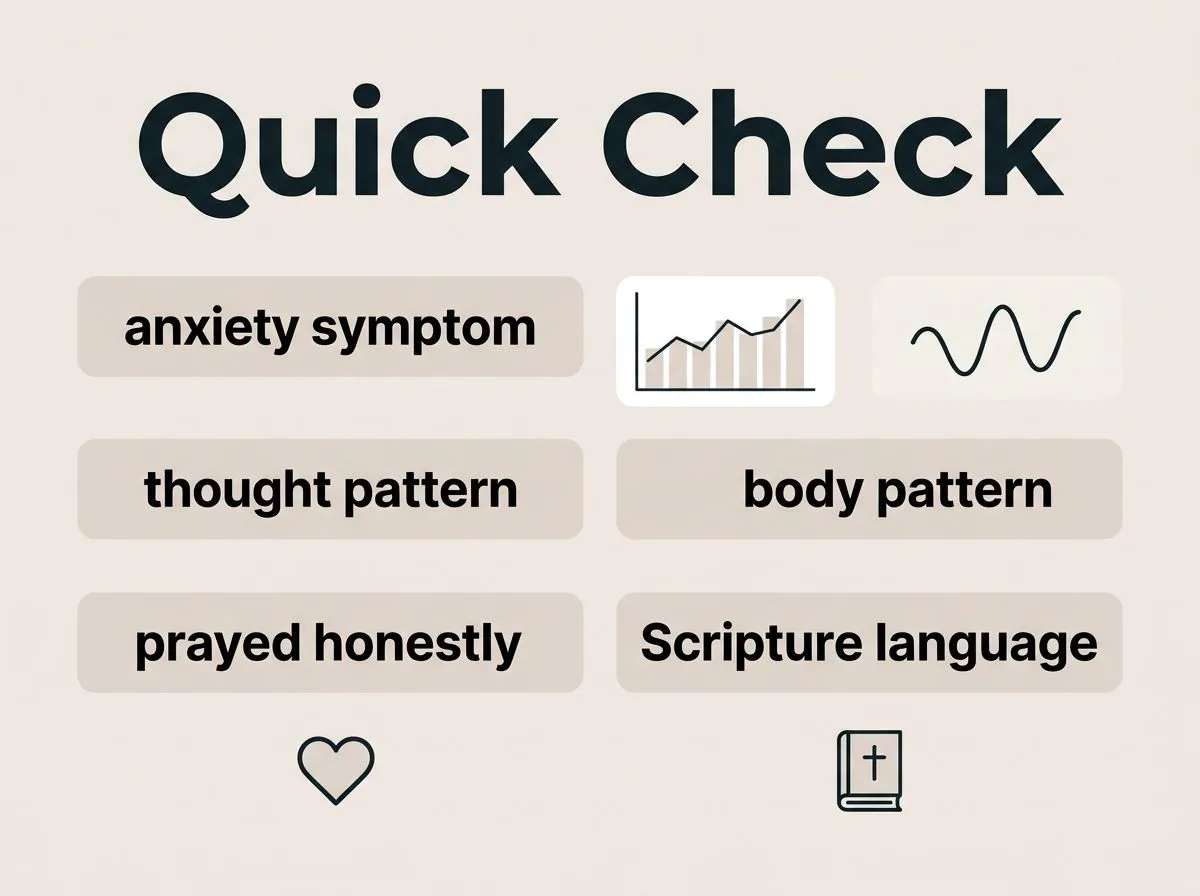
- You can name at least one anxiety symptom you have noticed, and it matches a pattern that affects your body, thoughts, or behavior rather than a single passing moment.
- You have prayed honestly using Scripture language, and the prayer included surrender, trust, and a request for God’s peace.
- You have chosen one verse, such as Philippians 4:6-7 or 1 Peter 5:7, and can use it again during the day without searching for a new prayer each time.
- You have decided whether your symptoms are interfering with sleep, work, school, relationships, or daily responsibilities, and you know whether that means booking a medical or mental health appointment.
- If you are having thoughts of self-harm or a dangerous panic episode, you have moved from reading to action by contacting emergency help or a crisis line right away.
Frequently asked questions
What is a short prayer for anxiety I can say right now?
Lord, I give You my worry and fear. Calm my heart, steady my mind, and fill me with Your peace. Help me trust You with what I cannot control. You can pray this in the morning, at bedtime, or in the middle of a panic-filled moment, even if all you can say is one honest sentence. In Jesus’ name, amen.
What Bible verse is best for anxiety?
Philippians 4:6-7 is one of the most comforting passages because it teaches prayer instead of panic and points to God’s peace that guards the heart and mind. It is especially helpful when your thoughts feel loud and scattered, because it gives you a clear way to bring your requests to God with thanksgiving.
Can anxiety go away with prayer alone?
Prayer can bring real comfort, but ongoing or severe anxiety may also need professional care. If symptoms keep returning, last for months, affect sleep, work, school, or relationships, or feel overwhelming, it is wise to talk with a doctor or therapist. Prayer and treatment can work together.
What should I pray for when I feel a panic attack starting?
Pray for calm breathing, a steady mind, and God’s nearness. Keep the prayer very short if needed, then focus on slow breaths and a quiet place while you wait for the wave to pass. If panic episodes are severe or you cannot function safely, get urgent help right away.


A Powerful Prayer for a Secure and Successful Future
A powerful prayer for a secure and successful future can bring peace when tomorrow feels uncertain. Questions about your family, career, finances, health, and…

A Powerful Prayer for Your Children’s Education and Future
A powerful prayer for your children’s education and future can help you place their learning, decisions, dreams, and challenges in God’s loving hands. Parents…

A Powerful Prayer for Anxiety, Stress, and Peace of Mind
A powerful prayer for anxiety, stress, and peace of mind can help you turn to God when your thoughts feel overwhelming and your heart cannot find rest. In mome…

A Powerful Prayer for Guidance When You Feel Lost
When uncertainty clouds your thoughts and every path seems confusing, a powerful prayer for guidance when you feel lost can help you slow down, seek God’s pres…